FIND THE MISSING SIDE OF RECTANGLE WHEN PERIMETER IS GIVEN
Subscribe to our ▶️ YouTube channel 🔴 for the latest videos, updates, and tips.
To find perimeter of rectangle, we use the formula
Perimeter = 2(length + width)
By applying the known values, we can solve for unknown.
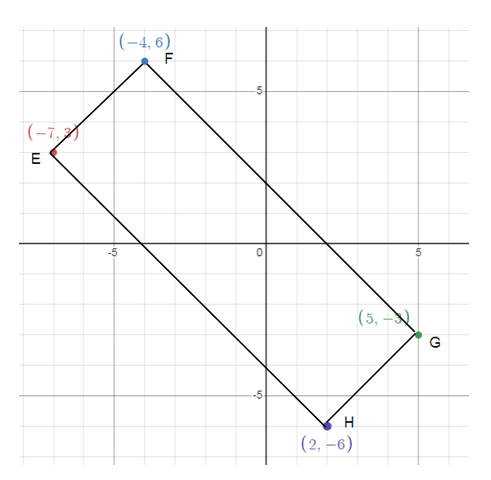
Problem 1 :
A rectangular field is to be fenced on three sides leaving a side of 20 feet uncovered. If the area of the field is 680 square feet, how many feet of fencing will be required ?
Solution :
Since it is rectangle, the opposite sides will be equal.
From the given information, we know that one of the side is 20 feet. Let x be the unknown side.
So, sides of the rectangle are x, x, 20, 20.
Area = 680
20x = 680
x = 680/20
x = 34
Length of fencing = Perimeter of the rectangular field (including three sides)
= x + x + 20
= 2x + 20
= 2(34) + 20
= 68 + 20
= 88
So, required length of fencing is 88 feet.
Problem 2 :
The ratio between the perimeter and the width of a rectangle is 5 : 1. If the area of the rectangle is 216 sq.cm. What is the length of the rectangle ?
Solution :
Perimeter = 5x and width = x
Let length = l and width = w
Perimeter : width = 5 : 1
l = 18
So, the required length is 18 cm.
Problem 3 :
A farmer wishes to start a 100 sq.m rectangular vegetable garden. Since he has only 30 m barbed wire he fences three sides of the garden letting his house compound wall act as the fourth side fencing. The dimension of the garden is.
Solution :
Let l be the length and w be the width of the rectangle.
Area of the vegetable garden = 100 sq.m
length x width = 100
l w = 100
w = 100/l ----(1)
length of fencing covering three sides = 30 m
l + l + w = 30
2l + w = 30
2l + (100/l) = 30
2l2 + 100 = 30l
2l2 - 30l + 100 = 0
l2 - 15l + 50 = 0
(l - 10) (l - 5) = 0
l = 10 and l = 5
|
If l = 10 w = 100/10 w = 10 |
If l = 5 w = 100/5 w = 20 |
So, the required dimension of the rectangle is 5 m x 20 m.
Problem 4 :
The length of a rectangle is three times of its width. If the length of the diagonal is 8√10 cm, then the perimeter of the rectangle is :
a) 15 √10 cm b) 16 √10 cm c) 24√10 cm d) 64 cm
Solution :
Let x be the width of the rectangle, then length = 3x
length of the diagonal = 8√10
x2 + (3x)2 = (8√10)2
x2 + 9x2 = 64(10)
10x2 = 64(10)
x2 = 64
x = 8
So, width of the rectangle is 8 cm, length = 3(8) ==> 24 cm.
Perimeter of the rectangle = 2(24 + 8)
= 2(32)
= 64 cm
So, option d is correct.
Problem 5 :
The length of a rectangle is halved, while its width is tripled. What is the percentage change in area ?
a) 25% increase b) 50% increase c) 50% decrease d) 75% decrease
Solution :
Let l and w be the length and width of original rectangle.
When length is halved, the new length will be l/2.
When width is tripled, the new width will be 3w.
Area of rectangle = (l/2)(3w)
= 3lw/2
Percentage change in area = (1.5lw - lw) / lw x 100%
= (0.5lw/lw) x 100%
= 0.5 x 100%
= 50%
50% increase. Option c is correct.
Problem 6 :
The length of a blackboard is 8 cm more than its width. If the length is increased by 7 cm and width is decreased by 4 cm, the area remains the same. The length and width of the blackboard will be
a) 28, 20 b) 34, 26 c) 40, 32 d) 56, 48
Solution :
Let x be the width of the rectangle.
Length = x + 8
After increasing the length by 7 cm, the new length = x + 8 + 7
= x + 15
After decreasing the width by 4 cm, the new width = x - 4
x(x + 8) = (x + 15)(x - 4)
x2 + 8x = x2 - 4x + 15x - 60
8x = 11x - 60
8x - 11x = -60
3x = 60
x = 20
x + 8 ==> 20 + 8 ==> 28 cm
So, the length and width of the rectangle is 28 cm and 20 cm.
Subscribe to our ▶️ YouTube channel 🔴 for the latest videos, updates, and tips.
Recent Articles


-
Finding Range of Values Inequality Problems
May 21, 24 08:51 PM
Finding Range of Values Inequality Problems -
Solving Two Step Inequality Word Problems
May 21, 24 08:51 AM
Solving Two Step Inequality Word Problems -
Exponential Function Context and Data Modeling
May 20, 24 10:45 PM
Exponential Function Context and Data Modeling