FIND THE EQUATION OF QUADRATIC FUNCTION FROM A GRAPH
Subscribe to our ▶️ YouTube channel 🔴 for the latest videos, updates, and tips.
The quadratic function which is in the standard form will be
y = ax2 + bx + c
this will have two roots α and β.
Roots = zeroes = x-intercepts
To find quadratic function from the given roots, we follow the steps give below.
Step 1 :
From the given graph, mark the zeroes and write them as values of x and convert it into factored form.
x = α ==> (x - α) (factor)
x = β ==> (x - β) (factor)
y = a(x - α)(x - β)
Step 2 :
To figure out the value of a, we will get one more point from the graph given except zeroes.
(i) It may be maximum or minimum point or y-intercept.
(ii) Mark it as point and apply in the quadratic function
(iii) Figure the value of a and simplify.
Determine the equation of quadratic function from graph. Give the function in general form.
Example 1 :
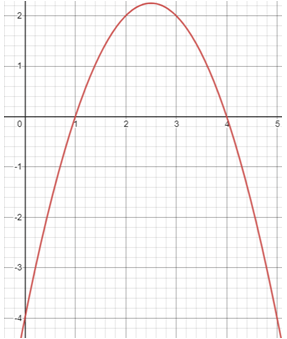
Solution :
From the graph, x-intercepts are 1 and 4.
So, x = 1 and x = 4
Factored form :
y = a(x - 1)(x - 4)
By observing the graph, the parabola cuts the y-axis at -4. By writing it as point (0, -4).
-4 = a(0 - 1)(0 - 4)
-4 = a(-1)(-4)
-4 = 4a
a = -1
y = -1(x - 1)(x - 4)
y = -1(x2 - 5x + 4)
y = -x2 + 5x - 4
Here the coefficient of x2 is -1, from the graph we have evidence that the parabola opens down.
Example 2 :
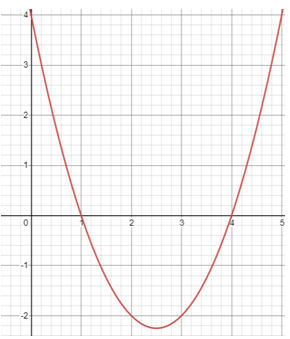
Solution :
From the graph, x-intercepts are 1 and 4.
So, x = 1 and x = 4
Factored form :
y = a(x - 1)(x - 4)
By observing the graph, the parabola cuts the y-axis at -4. By writing it as point (0, 4).
4 = a(0 - 1)(0 - 4)
4 = a(-1)(-4)
4 = 4a
a = 1
y = 1(x - 1)(x - 4)
y = 1(x2 - 5x + 4)
y = x2 - 5x + 4
Here the coefficient of x2 is 1, from the graph we have evidence that the parabola opens up.
Example 3 :
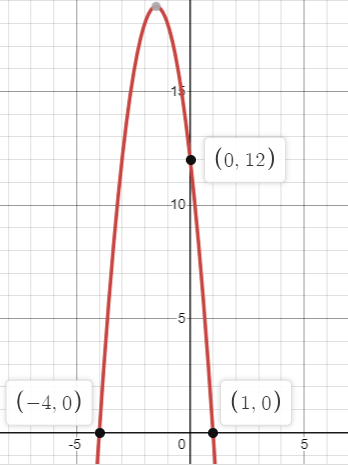
Solution :
From the graph, x-intercepts are -4 and 1.
So, x = -4 and x = 1
Factored form :
y = a(x + 4)(x - 1)
By observing the graph, the parabola cuts the y-axis at 12. By writing it as point (0, 12).
12 = a(0 + 4)(0 - 1)
12 = -4a
a = -3
y = -3(x + 4)(x - 1)
y = -3(x2 + 3x - 4)
y = -3x2 - 9x + 12
Here the coefficient of x2 is -3, from the graph we have evidence that the parabola opens down.
Example 4 :
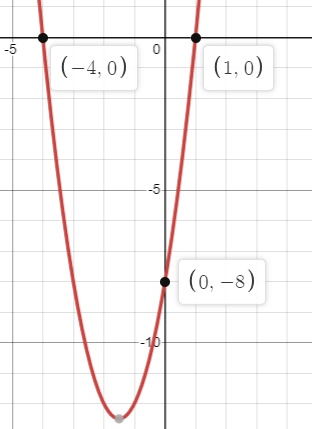
Solution :
From the graph, x-intercepts are -4 and 1.
So, x = -4 and x = 1
Factored form :
y = a(x + 4)(x - 1)
By observing the graph, the parabola cuts the y-axis at -8. By writing it as point (0, -8).
-8 = a(0 + 4)(0 - 1)
-8 = -4a
a = 2
y = 2(x + 4)(x - 1)
y = 2(x2 + 3x - 4)
y = 2x2 + 6x - 8
Here the coefficient of x2 is 2, from the graph we have evidence that the parabola opens up.
Example 5 :
Solution :
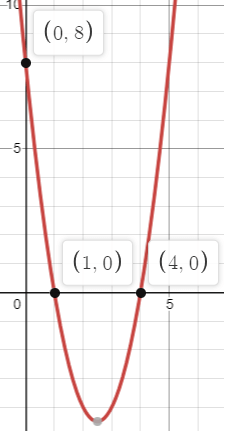
From the graph, x-intercepts are 4 and 1.
So, x = 4 and x = 1
Factored form :
y = a(x - 4)(x - 1)
By observing the graph, the parabola cuts the y-axis at -8. By writing it as point (0, 8).
8 = a(0 - 4)(0 - 1)
8 = 4a
a = 2
y = 2(x - 4)(x - 1)
y = 2(x2 - 5x + 4)
y = 2x2 - 10x + 8
Here the coefficient of x2 is 2, from the graph we have evidence that the parabola opens up.
Example 6 :
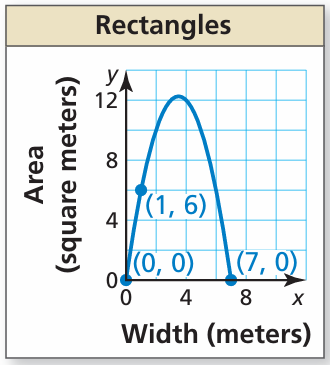
The area of a rectangle is modeled by the graph where y is the area (in square meters) and x is the width (in meters). Write an equation of the parabola. Find the dimensions and corresponding area of one possible rectangle. What dimensions result in the maximum area?
Solution :
By observing the graph, the x-intercepts are 0 and 7
The factored form is (x - 0)(x - 7)
f(x) = a(x)(x - 7)
The parabola passes through the point (1, 6), then
f(1) = a(1)(1 - 7)
6 = a(-6)
a = -1
Applying the value of a, we get
f(x) = -x(x - 7)
Width of the rectangle = (0 + 7)/2
= 3.5 meters
f(3.5) = -3.5(3.5 - 7)
= -3.5 (-3.5)
= 12.25 square meter
So, the rectangle with dimension with the measure of 3.5 m by 3.5 m.
Example 7 :
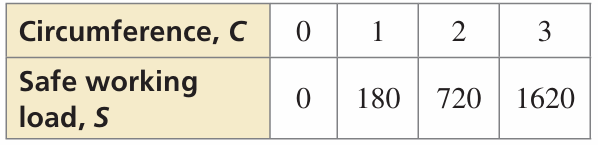
Every rope has a safe working load. A rope should not be used to lift a weight greater than its safe working load. The table shows the safe working loads S (in pounds) for ropes with circumference C (in inches). Write an equation for the safe working load for a rope. Find the safe working load for a rope that has a circumference of 10 inches.
Solution :
y = a(x - p)(x - q)
Here x -intercept is 0.
y = a(x - 0)(x - q)
y = a(x)(x - q)
The parabola passes through the points (1, 180) and (2, 720)
180 = a(1)(1 - q)
180 = a(1 - q)
a = 180 / (1 - q) -----(1)
720 = a(2)(2 - q)
720 = 2a(2 - q)
360 = a(2 - q)
a = 360 / (2 - q) -----(2)
(1) = (2)
180 / (1 - q) = 360 / (2 - q)
(2 - q)/(1 - q) = 360/180
(2 - q)/(1 - q) = 2
2 - q = 2(1 - q)
2 - q = 2 - 2q
2 - 2 = -2q + q
q = 0
Applying the value of q, we get
a = 180 / (1 - 0)
a = 180
Applying these values, we get
y = 180(x)(x - 0)
y = 180x2
Subscribe to our ▶️ YouTube channel 🔴 for the latest videos, updates, and tips.
Recent Articles


-
Finding Range of Values Inequality Problems
May 21, 24 08:51 PM
Finding Range of Values Inequality Problems -
Solving Two Step Inequality Word Problems
May 21, 24 08:51 AM
Solving Two Step Inequality Word Problems -
Exponential Function Context and Data Modeling
May 20, 24 10:45 PM
Exponential Function Context and Data Modeling