FIND THE EQUATION OF A TRANSFORMED QUADRATIC FUNCTION FROM A GRAPH
Subscribe to our ▶️ YouTube channel 🔴 for the latest videos, updates, and tips.
y = a(x - h)2 + k
is the equation of parabola which is having the vertex (h, k)
The sign of a will decide if there is any reflection or not.
- The sign of a is positive, the parabola will open up
- The sign of a is negative, the parabola will open down.
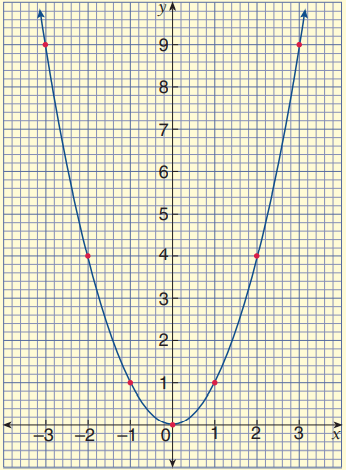
The parabolas shown are the result of translating and/or reflecting the parabola y = x2. Find the equation of each parabola.
Problem 1 :
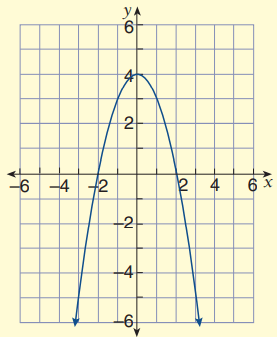
Solution :
Since the parabola opens down, there is a reflection.
a = -1
Horizontally the graph of y = -x2 is not moved.
Vertically the graph of y = -x2 is moved 4 units up.
h = 0 and k = 4
y = -1(x - 0)2 + 4
So, the equation from the given graph is
y = -1x2 + 4
Problem 2 :
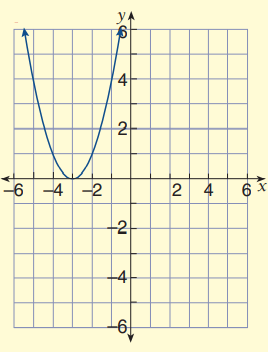
Solution :
Since the parabola opens down, there is no reflection.
a = 1
Horizontally the graph of y = x2 is moved 3 units to the left.
Vertically the graph of y = -x2 is not moved.
h = -3 and k = 0
y = 1(x - (-3))2 + 0
So, the equation from the given graph is
y = (x + 3)2
Problem 3 :
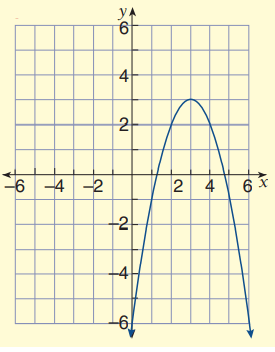
Solution :
Since the parabola opens down, there is reflection.
a = -1
Horizontally the graph of y = -x2 is moved 3 units to the right.
Vertically the graph of y = -x2 is moved 3 units up.
h = 3 and k = 3
y = -1(x - 3)2 + 3
So, the equation from the given graph is
y = -(x - 3)2 + 3
Problem 4 :
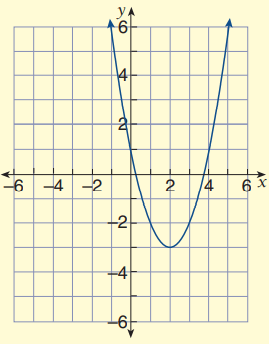
Solution :
Since the parabola opens down, there is no reflection.
a = 1
Horizontally the graph of y = x2 is moved 2 units to the right.
Vertically the graph of y = x2 is moved 3 units down.
h = 2 and k = -3
y = 1(x - 2)2 - 3
So, the equation from the given graph is
y = 1(x - 2)2 - 3
Problem 5 :
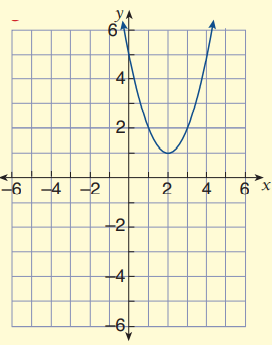
Solution :
Since the parabola opens down, there is no reflection.
a = 1
Horizontally the graph of y = x2 is moved 2 units to the right.
Vertically the graph of y = x2 is moved 1 unit up.
h = 2 and k = 1
y = 1(x - 2)2 + 1
So, the equation from the given graph is
y = (x - 2)2 + 1
Problem 6 :
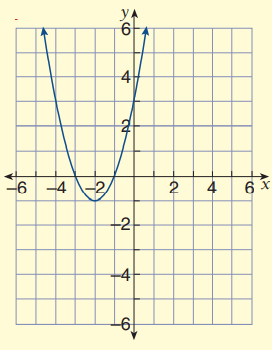
Solution :
Since the parabola opens down, there is no reflection.
a = 1
Horizontally the graph of y = x2 is moved 2 units left.
Vertically the graph of y = x2 is moved 1 unit down.
h = -2 and k = -1
y = 1(x - (-2))2 - 1
So, the equation from the given graph is
y = (x + 2)2 - 1
Problem 7 :
Describe the transformation of the graph of the parent quadratic function. Then identify the vertex.
f(x) = 2(x + 3)2 + 2
Solution :
f(x) = 2(x + 3)2 + 2
f(x) = 2(x - (-3))2 + 2
Comparing with f(x) = x2
- Vertical stretch of 2
- Moving the parabola 2 units up
- Moving the parabola 3 units left.
- Vertex is (-3, 2)
Problem 8 :
write a rule for g described by the transformations of the graph of f. Then identify the vertex.
f(x) = x2
vertical stretch by a factor of 4 and a reflection in the x-axis, followed by a translation 2 units up
Solution :
f(x) = x2
|
Vertical stretch by the factor of 4 Reflection in the x-axis Translation 2 units up. |
f(x) = 4x2 f(x) = -4x2 f(x) = -4(x - (-2))2 |
f(x) = -4(x + 2)2
So, the required quadratic function is f(x) = -4(x + 2)2
Problem 9 :
Match the function with its graph. Explain your reasoning.
a) g(x) = 2(x − 1)2 − 2
b) g(x) = 1/2 ( x + 1)2 − 2
c) g(x) = −2(x − 1)2 + 2
d) g(x) = 2(x + 1)2 + 2
e) g(x) = −2(x + 1)2 − 2
f) g(x) = 2(x − 1)2 + 2
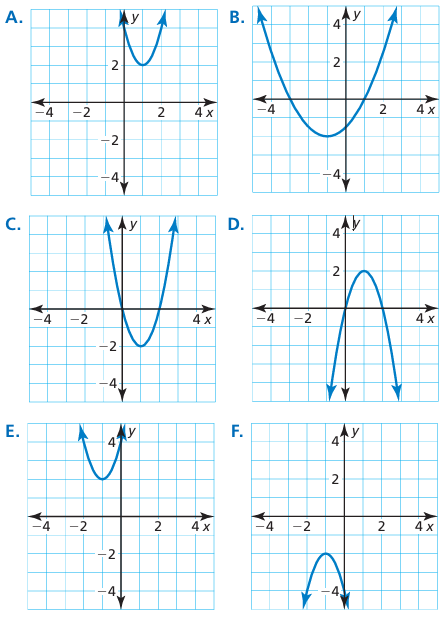
Solution :
a) g(x) = 2(x − 1)2 − 2
- Vertical stretch of 2
- Moving horizontally 1 unit to the right
- Moving vertically 2 units down.
Option C is correct.
b) g(x) = 1/2 (x + 1)2 − 2
- Vertical shrink of 1/2
- Moving horizontally 1 unit to the left
- Moving vertically 2 units down.
Option B is correct.
c) g(x) = −2(x − 1)2 + 2
- Vertical stretch of 2, opens down.
- Moving horizontally 1 unit to the right
- Moving vertically 2 units up
Option D is correct.
d) g(x) = 2(x + 1)2 + 2
- Vertical stretch of 2, opens up.
- Moving horizontally 1 unit to the left
- Moving vertically 2 units up
Option E is correct.
e) g(x) = −2(x + 1)2 − 2
- Vertical stretch of 2, opens down
- Moving horizontally 1 unit to the left
- Moving vertically 2 units down
Option F is correct.
f) g(x) = 2(x − 1)2 + 2
- Vertical stretch of 2, opens up.
- Moving horizontally 1 unit to the right
- Moving vertically 2 units up
Option A is correct.
Subscribe to our ▶️ YouTube channel 🔴 for the latest videos, updates, and tips.
Recent Articles


-
Finding Range of Values Inequality Problems
May 21, 24 08:51 PM
Finding Range of Values Inequality Problems -
Solving Two Step Inequality Word Problems
May 21, 24 08:51 AM
Solving Two Step Inequality Word Problems -
Exponential Function Context and Data Modeling
May 20, 24 10:45 PM
Exponential Function Context and Data Modeling