FIND SLANT HEIGHT OF CONE GIVEN SURFACE AREA AND RADIUS
Subscribe to our ▶️ YouTube channel 🔴 for the latest videos, updates, and tips.
To find lateral surface area and total surface area of cone, we use the formulas given below.
Lateral surface area = πrl
Total surface area = πrl + πr2
= πr(l + r)
Here r = radius, l = slant height
Find slant height of the following cones given below.
Problem 1 :
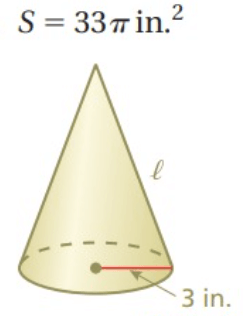
Solution :
Total surface area = πr(l + r)
πr(l + r) = 33π
radius(r) = 3
3π(l + 3) = 33π
3(l + 3) = 11
Subtracting 3 on both sides.
l = 11 - 3
l = 8
So, the required slant height is 8 inches.
Problem 2 :

Solution :
Total surface area = πr(l + r)
πr(l + r) = 126π
diameter = 12 cm
radius(r) = 6 cm
6π(l + 6) = 126π
6(l + 6) = 126
Dividing by 6 on both sides.
l + 6 = 21
Subtracting 6 on both sides.
l = 21 - 6
l = 15
So, the required slant height is 15 cm.
Problem 3 :

Solution :
Total surface area = πr(l + r)
πr(l + r) = 60π
radius(r) = 5 ft
5π(l + 5) = 60π
5(l + 5) = 60
Dividing by 5 on both sides.
l + 5 = 12
Subtracting 5 on both sides.
l = 12 - 5
l = 7
So, the required slant height is 7 ft.
Problem 4 :

Solution :
Total surface area = πr(l + r)
πr(l + r) = 216π
radius(r) = 9 cm
9π(l + 9) = 216π
9(l + 9) = 216
Dividing by 9 on both sides.
l + 9 = 24
Subtracting 9 on both sides.
l = 24-9
l = 15
So, the required slant height is 15 cm
Problem 5 :
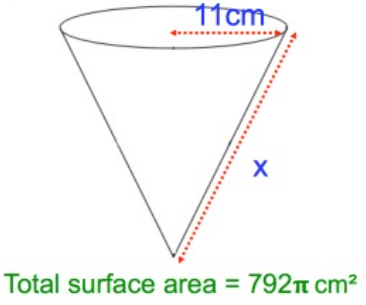
Solution :
Total surface area = πr(l + r)
πr(l + r) = 792π
radius(r) = 11 cm
11π(x + 11) = 792π
11(x + 11) = 792
Dividing by 11 on both sides.
x + 11 = 72
Subtracting 11 on both sides.
x = 72 - 11
x = 61
So, the required slant height is 61 cm
Problem 6 :

Solution :
Total surface area = πr(l + r)
πr(l + r) = 100π
radius(r) = 2 cm
2π(x + 2) = 100π
2(x + 2) = 50
Dividing by 2 on both sides.
x + 2 = 25
Subtracting 2 on both sides.
x = 25 - 2
x = 23
So, the required slant height is 23 cm.
Problem 7 :
Find the volume of the cone
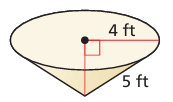
Solution :
Let r, l and h be radius, slant height and height of the cone.
l2 = r2 + h2
52 = 42 + h2
h2 = 25 - 16
h2 = 9
h = 3
Volume of cone = (1/3) πr2h
= (1/3) x 3.14 x 42 x 3
= (1/3) x 3.14 x 16 x 9
= 150.72 square feet
find the missing dimension(s) when Volume = 75.4 cm3
Problem 8 :
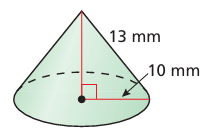
Solution :
Radius = 10 mm, slant height (l) = 13 mm
l2 = r2 + h2
Applying the know values, we get
132 = 102 + h2
169 - 100 = h2
h2 = 69
h = √69
= 8.3 mm
Volume of cone = (1/3) πr2h
= (1/3) x 3.14 x 102 x 8.3
= 868.73 cubic mm
Problem 9 :
A cone has a diameter of 11.5 inches and a slant height of 15.2 inches
Solution :
Radius (r) = 11.5/2 inches ==> 5.75 inches
slant height (l) = 15.2 inches
l2 = r2 + h2
Applying these values, we get
15.22 = 5.752 + h2
231.04 - 33.0625 = h2
h2 = 197.97
h = √197.97
= 14.07
Approximately 14.1 inches
Problem 10 :
A right cone-shaped funnel has a height of 8 centimeters and a diameter of 4.8 centimeters. Find the volume of the cone and slant height.
Solution :
Radius (r) = 4.8/2 ==> 2.4 cm
height (h) = 8 cm
l2 = r2 + h2
Applying these values, we get
l2 = 2.42 + 82
= 5.76 + 64
l2 = 69.76
l = √69.76
l = 8.35 cm
Volume of cone = (1/3) πr2h
= (1/3) x 3.14 x 2.42x 8
= 48.23 cm2
Problem 11 :
A cone has height h and a base with radius r. You want to change the cone so its volume is doubled. What is the new height if you change only the height ? What is the new radius if you change only radius ?
Solution :
Let h be the height and r be the radius.
Volume of cone = (1/3) πr2h
When volume doubled, then
Volume of new cone = (2/3) πr2h
= (1/3) πr2(2h)
So, the height should be doubled.
While changing radius :
Volume of new cone = (2/3) πr2h
= (1/3) π(√2r)2(h)
The new radius should be √2r.
Problem 12 :
A glass in the shape of a right cone has a diameter of 3.3 inches and a slant height of 5.5 inches. Find the height of the cone.
Solution :
Radius (r) = 3.3/2 inches ==> 1.65 inches
slant height (l) = 5.5 inches
l2 = r2 + h2
Applying these values, we get
5.52 = 1.652 + h2
30.25 - 2.7225 = h2
h2 = 27.5275
h = √27.5275
= 5.24
So, the required height is 5.24 inches.
Subscribe to our ▶️ YouTube channel 🔴 for the latest videos, updates, and tips.
Recent Articles


-
Finding Range of Values Inequality Problems
May 21, 24 08:51 PM
Finding Range of Values Inequality Problems -
Solving Two Step Inequality Word Problems
May 21, 24 08:51 AM
Solving Two Step Inequality Word Problems -
Exponential Function Context and Data Modeling
May 20, 24 10:45 PM
Exponential Function Context and Data Modeling