FIND RADIUS OF CONE WHEN GIVEN SURFACE AREA
Subscribe to our ▶️ YouTube channel 🔴 for the latest videos, updates, and tips.
To find lateral surface area and total surface area of cone, we use the formulas given below.
Lateral surface area = πrl
Total surface area = πrl + πr2
= πr(l + r)
Here r = radius, l = slant height
Find length of radius of the following cones given below.
Problem 1 :
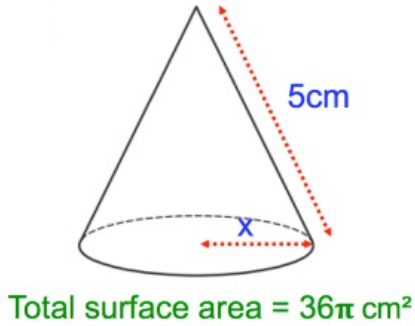
Solution :
Total surface area = πr(l + r)
πr(l + r) = 36π
radius(r) = x and slant height (l) = 5 cm
xπ(5 + x) = 36π
5x + x2 = 36
x2 + 5x - 36 = 0
(x + 9) (x - 4) = 0
x = -9 and x = 4
So, the required radius is 4 cm.
Problem 2 :
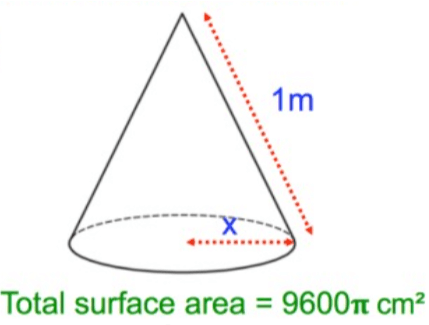
Solution :
Total surface area = πr(l + r)
πr(l + r) = 9600π
radius(r) = x and slant height (l) = 1 m = 100 cm
xπ(100 + x) = 9600π
100x + x2 = 9600
x2 + 100x - 9600 = 0
(x + 160)(x - 60) = 0
x = -160 and x = 60
So, the radius is 60 cm.
Problem 3 :
The cylinder and cone has the same surface area. Express L in terms of x.
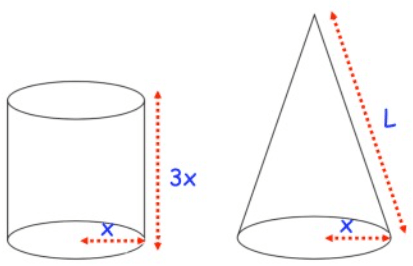
Solution :
Surface area of cylinder = 2πr(h + r)
Surface area of cone = πr(l + r)
height of cylinder = 3x and slant height of cone = l
2πx(3x + x) = πx(l + x)
2x(4x) = x(l + x)
8x2 = lx + x2
Subtracting x2 on both sides.
7x2 = lx
l = 7x
Problem 4 :
A cone and cylinder are joined to make a solid
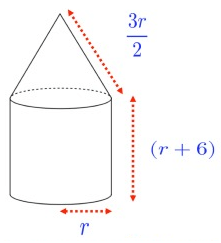
Find the total surface area of the solid.
Solution :
Total surface area of the figure given above =
lateral surface area of cylinder + lateral surface area of cone
= 2πrh + πrl
= πr(2h + l)
= πr(2(r+6) + (3r/2))
= πr(2r + 12 + (3r/2))
= πr((4r + 24 + 3r)/2)
= πr((7r + 24)/2)
Problem 5 :
You are making a skylight that has 12 triangular pieces of glass and a slant height of 3 feet. Each triangular piece has a base of 1 foot

Solution :
Area of triangular piece = (1/2) x base x height
base = 0.5 feet, slant height = 3 feet
l2 = r2 + h2
32 = 0.52 + h2
h2 = 9 - 0.25
h2 = 8.75
h = √8.75
h = 2.95 feet
Area of triangular pieces cone = 12 x (1/2) x 0.5 x 2.95
= 6 x 0.5 x 2.95
= 8.85 square feet
Problem 6 :
A wooden toy is in the form of a cone surmounted on a hemisphere. The diameter of the base of the cone is 6 cm and its height is 4 cm. find the cost of painting the toy at the rate of dollar, 5 per 1000 cm2.
Solution :
Diameter = 6 cm, radius = 3 cm and height = 4 cm
l2 = r2 + h2
l2 = 32 + 42
l2 = 9 + 16
l2 = 25
l = 5 cm
area to be painted = Surface area of cone + surface area of hemisphere
= πrl + 2πr2
= πr(l + 2r)
= 3.14(3)(5 + 2(3))
= 9.42(5 + 6)
= 9.42(11)
= 103.62 square cm
$5 per 1000 cm2
1 cm2 = 5/1000
103.62 square cm = (1/200) x 103.62
= $0.51
So, the required cost is $0.51.
Problem 7 :
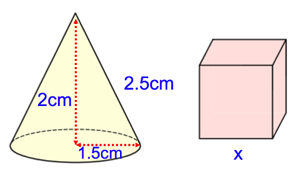
The cone and cube below have the same surface areas. Work out the side length of the cube.
Solution :
Surface area of cone = surface area of cube
πrl = 4a2
3.14 x 1.5 x 2.5 = 4x2
x2 = (3.14 x 1.5 x 2.5)/4
x2 = 2.943
x = 1.71
So, the side length of the cube is 1.71 cm.
Problem 8 :
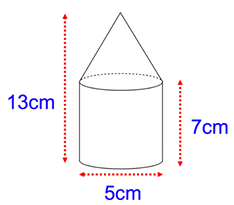
The diagram shows a solid shape. The shape is a cone on top of a cylinder. Work out the surface area of the shape. Give your answer correct to 2 significant
Solution :
Radius = 2.5 cm, height of cylinder = 7 cm, height of cone = 13 - 7 ==> 6 cm
Slant height of cone l2 = r2 + h2
l2 = 2.52 + 62
l2 = 6.25 + 36
l2 = 42.25
l = 6.5 cm
Surface area of the shape = surface area of cylinder + surface area of cone
= 2πrh + πrl
= πr(2h + l)
= 3.14 x 2.5 [2(7) + 6.5]
= 7.85[14 + 6.5]
= 7.85 (20.5)
= 160.92 cm2
Problem 9 :
A cone has a radius of 9 cm. The surface area of the cone is 450 π cm² Work out the volume of the cone. Give your answer in terms of π
Solution :
Radius = 9 cm
Surface area = 450 π cm²
Volume of cone = 1/3 πr2 h
πrl = 450 π
9 x l = 450
l = 450/9
l = 50
l2 = r2 + h2
502 = 92 + h2
2500 - 81 = h2
h2 = 2419
h = 49.18
Applying these values, we get
= 1/3 x 3.14 x 92 x 49.18
= 1.04 x 81 x 49.18
= 4142.92 cm3
Problem 10 :
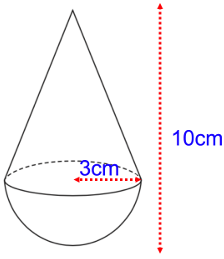
The diagram shows a solid shape. The shape is a cone on top of a hemisphere. Work out the surface area of the shape. Give your answer correct to 2 significant figure.
Solution :
Surface area of the figure = Surface area of hemisphere + surface area of cone
= (2/3) πr3 + πrl
Radius of hemisphere = radius of cone = 3 cm, height of cone = 10 - 3 ==> 7 cm
l2 = r2 + h2
l2 = 32 + 72
= 9 + 49
l2 = 58
l = √58
l = 7.61
= πr[(2/3)r2 + l]
= π(3)[(2/3)32 + 7.61]
= 3π18+7.61]
= 76.83π cm2
Subscribe to our ▶️ YouTube channel 🔴 for the latest videos, updates, and tips.
Recent Articles


-
Finding Range of Values Inequality Problems
May 21, 24 08:51 PM
Finding Range of Values Inequality Problems -
Solving Two Step Inequality Word Problems
May 21, 24 08:51 AM
Solving Two Step Inequality Word Problems -
Exponential Function Context and Data Modeling
May 20, 24 10:45 PM
Exponential Function Context and Data Modeling