FIND MISSING VALUES INVOLVING ISOSCELES TRAPEZOID
Subscribe to our ▶️ YouTube channel 🔴 for the latest videos, updates, and tips.
What is Trapezium ?
A trapezium is a convex quadrilateral with exactly one pair of opposite sides parallel to each other. The trapezium is a two-dimensional are called legs. It is also called a trapezoid. Sometimes the parallelogram is also called a trapezoid with two parallel sides.
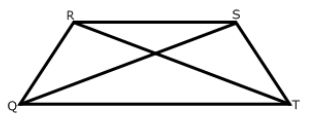
Properties :
(i) All the properties of a trapezoid
(ii) Non-parallel sides are congruent.
(iii) Diagonals are congruent.
(iv) Base angles are congruent.
(v) Opposite angles are supplementary
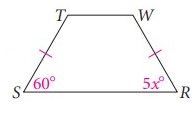
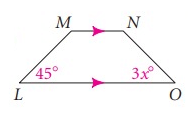
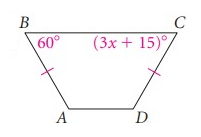
Find the value of the variable in each isosceles trapezoid.
Problem 1 :
Solution :
By observing the figure,
WR = TS
5xº = 60º
xº = 60º/5
xº = 12
Problem 2 :
Solution :
Non parallel sides will be congruent. So,
NO = ML
3xº = 45º
xº = 45º/3
xº = 15
Problem 3 :
Solution :
By observing the figure,
DC = AB
(3x + 15)º = 60º
3xº + 15º = 60º
3xº = 60º - 15º
3xº = 45º
x = 45º/3
x = 15º
Problem 4 :
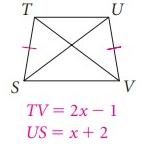
Solution :
By observing the figure,
TV = US
2x – 1 = x + 2
Comparing like terms.
2x – x = 2 + 1
x = 3
Problem 5 :
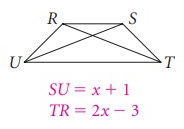
Solution :
In a isosceles trapezium, diagonals are equal,
SU = TR
x + 1 = 2x - 3
x – 2x = -3 - 1
-x = -4
x = 4
Problem 6 :
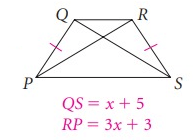
Solution :
By observing the figure, it is isosceles trapezium. In which diagonals will be equal.
QS = RP
x + 5 = 3x + 3
Comparing like terms.
x – 3x = 3 - 5
-2x = -2
Divide both sides by -2.
x = 1
Problem 7 :
If the diagonals of a quadrilateral do not bisect each other, then the quadrilateral could be a
a) rectangle b) rhombus c) square d) trapezoid
Solution :
In the quadrilaterals, square, rectangle, parallelogram and rhombus the diagonals will bisect each other.
In trapezium, the diagonals will not bisect each other.
Problem 8 :
In trapezoid RSTV with bases RS and VT, diagonals RT and SV intersect at Q
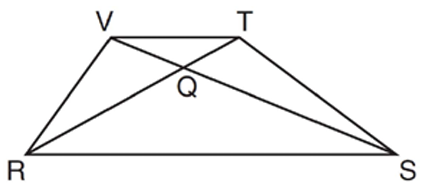
If trapezoid RSTV is not isosceles, which triangle is equal in area to RSV?
a) RQV b) RST c) RVT d) SVT
Solution :
There is a relationship between the quadrilateral RSVT and triangles RVT and SVT since they lie on the same base.
Area of quadrilateral RSVT = (1/2) area of triangle RVT ------(1)
Area of quadrilateral RSVT = (1/2) area of triangle SVT------(2)
(1) = (2)
(1/2) area of triangle RVT = (1/2) area of triangle SVT
Area of triangle RVT = Area of triangle SVT
Similarly,
Area of quadrilateral RSVT = (1/2) area of triangle RSV ------(3)
Area of quadrilateral RSVT = (1/2) area of triangle RST------(4)
(3) = (4)
(1/2) area of triangle RSV = (1/2) area of triangle RST
area of triangle RSV = area of triangle RST
So, option b is correct.
Problem 9 :
In the diagram below of isosceles trapezoid STAR, diagonals AS and RT intersect at O and ST || RA, with nonparallel sides SR and TA.
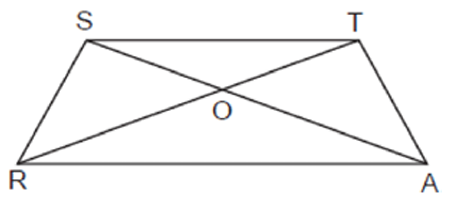
Which pair of triangles are not always similar?
a) STO and ARO b) SOR and TOA
c) SRA and ATS d) SRT and TAS
Solution :
Option a :
STO and ARO
ST || RA
∠SOT = ∠ROA
∠TSO = ∠RAO
Alternate interior angles will be equal.
So, triangles STO and ARO are similar.
Option b :
SOR and TOA
∠SOR = ∠TOA
∠SRO = ∠ATO
So, triangles SOR and TOA are similar.
Option c :
These are not always similar. While they are congruent in a perfect isosceles trapezoid, they are not necessarily similar to other triangles in the diagram, and without further information regarding angle measures or side ratios, they do not consistently meet the similarity criteria compared to the other pairs, according to standard geometric proofs.
Problem 10 :
Isosceles trapezoid ABCD has diagonals AC and BD. If AC = 5x + 13 and BD = 11x − 5, what is the value of x?
a) 28 b) 10 3/4 c) 3 d) 1/2
Solution :
The diagonals of an isosceles trapezoid are congruent.
5x + 13 = 11x − 5
5x - 11x = - 5 - 13
-6x = -18
x = 18/6
x = 3
So, option c is correct.
Problem 11 :
The cross section of an attic is in the shape of an isosceles trapezoid, as shown in the accompanying figure. If the height of the attic is 9 feet, BC = 12 feet, and AD = 28 feet, find the length of AB to the nearest foot.
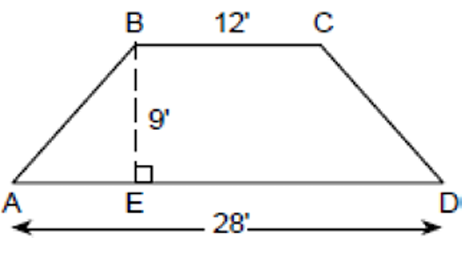
Solution :
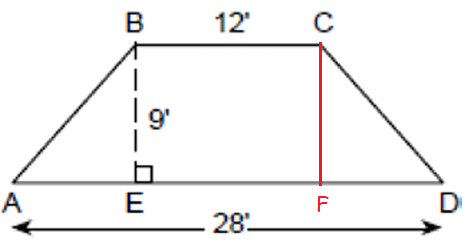
AD = AE + EF + FD
28 = AE + 12 + FD
AE = FD
28 = AE + 12 + AE
2AE = 28 - 12
= 16
AE = 16/2
AE = 8'
FD = 8'
In triangle ABE,
AB2 = AE2 + EB2
AB2 = 82 + 92
= 64 + 81
AB2 = 145
AB = √145
= 12.0
So, the length of AB is approximately 12 feet.
Subscribe to our ▶️ YouTube channel 🔴 for the latest videos, updates, and tips.
Recent Articles


-
Finding Range of Values Inequality Problems
May 21, 24 08:51 PM
Finding Range of Values Inequality Problems -
Solving Two Step Inequality Word Problems
May 21, 24 08:51 AM
Solving Two Step Inequality Word Problems -
Exponential Function Context and Data Modeling
May 20, 24 10:45 PM
Exponential Function Context and Data Modeling