FIND DOMAIN AND RANGE OF ABSOLUTE VALUE FUNCTION
Subscribe to our ▶️ YouTube channel 🔴 for the latest videos, updates, and tips.
Domain :
The set of all possible inputs is known as domain. For absolute value functions all real numbers will be domain.
Because there is no restriction to give inputs. So, for all absolute value functions domain will be (-∞, ∞).
Range :
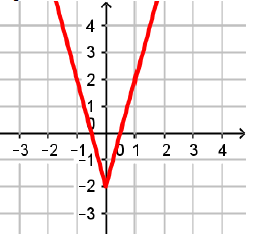
This graph will not go below -2 on y-axis. So, range is
-2 ≤ y ≤∞
Find the domain and range of each function
Problem 1 :
y = │x│
Solution :
Domain : (-∞, ∞), x ∈ R
Range : [0, ∞), y ≥ 0
Problem 2 :
y = -│x│
Solution :
Domain : (-∞, ∞), x ∈ R
Range : [0, -∞), y ≤ 0
Problem 3 :
y = │x + 2│+ 3
Solution :
Domain: (-∞, ∞), x ∈ R
Range: [3, ∞), y ≥ 3
Problem 4 :
y = │x│- 5
Solution :
Domain: (-∞, ∞), x ∈ R
Range: [-5, ∞), y ≥ -5
Problem 5 :
y = -│x│- 9
Solution :
Domain: (-∞, ∞), x ∈ R
Range: [-9, -∞), y ≤ -9
Problem 6 :
y = -│x - 3│+ 10
Solution :
Domain: (-∞, ∞), x ∈ R
Range: [10, -∞), y ≤ 10
Problem 7 :
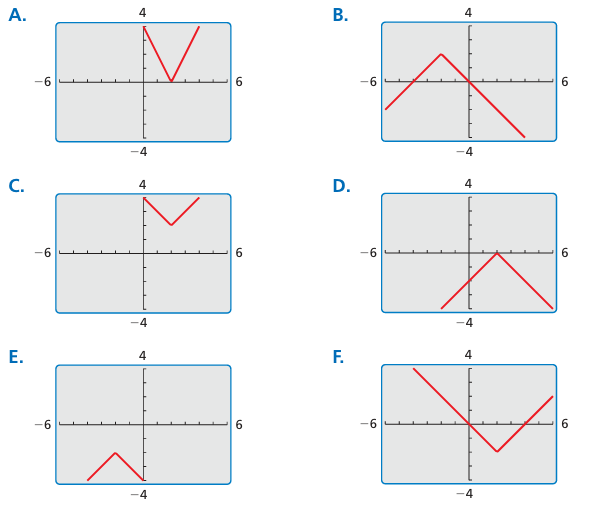
Match each absolute value function with its graph. Then use a graphing calculator to verify your answers.
|
a. g(x) = − ∣x − 2∣ b. g(x) = ∣x − 2∣ + 2 c. g(x) = − ∣x + 2∣ − 2 |
d. g(x) = ∣x − 2∣ − 2 e. g(x) = 2 ∣x − 2∣ f. g(x) = − ∣x + 2∣ + 2 |
Solution :
a. g(x) = − ∣x − 2∣
Comparing the given function with y = a|x - h| + k
Since the sign of a is negative, it must be open down. Vertex is at (2, 0). So, option D is correct.
b. g(x) = ∣x − 2∣ + 2
Since the sign of a is positive, it must be open up. Vertex is at (2, 2). So, option C is correct.
c. g(x) = − ∣x + 2∣ − 2
Since the sign of a is negative, it must be open down. Vertex is at (-2, -2). So, option E is correct.
d. g(x) = ∣x − 2∣ − 2
Since the sign of a is positive, it must be open up. Vertex is at (2, -2). So, option F is correct.
e. g(x) = 2 ∣x − 2∣
Since the sign of a is positive, it must be open up. Vertex is at (2, 0). Vertical stretch of 2. So, option A is correct.
f. g(x) = − ∣x + 2∣ + 2
Since the sign of a is negative, it must be open down. Vertex is at (-2, 2). So, option B is correct.
Problem 8 :
Graph the function. Compare the graph to the graph of f(x) = ∣x∣ . Describe the domain and range.
a) h(x) = ∣x∣ − 1
b) n(x) = ∣x + 4∣
Solution :
a) h(x) = ∣x∣ − 1
Vertex is at (0, -1).
Domain is all real values
Range is the values of y greater than or equal to -1.
Domain: (-∞, ∞), x ∈ R
Range: [-1, ∞), y ≤ -1
b) n(x) = ∣x + 4∣
Vertex is at (-4, 0).
Domain is all real values
Range is the values of y greater than or equal to 0.
Domain: (-∞, ∞), x ∈ R
Range: [0, ∞), y ≤ 0
Problem 9 :
Compare the graphs of p(x) = ∣x − 6∣ and q(x) = ∣x∣ − 6.
Solution :
For the function p(x) = ∣x − 6∣
Vertex is at (6, 0).
Domain is all real values
Range is the values of y greater than or equal to 0.
Domain: (-∞, ∞), x ∈ R
Range: [0, ∞), y ≤ 0
For the function q(x) = ∣x∣ − 6.
Vertex is at (0, -6).
Domain is all real values
Range is the values of y greater than or equal to -6.
Domain: (-∞, ∞), x ∈ R
Range: [-6, ∞), y ≤ -6
Problem 10 :
Comparing the parent function, the graph of p(x) should be moving the graph 6 units towards left. Graph of q(x) should be moving the graph 6 units down.
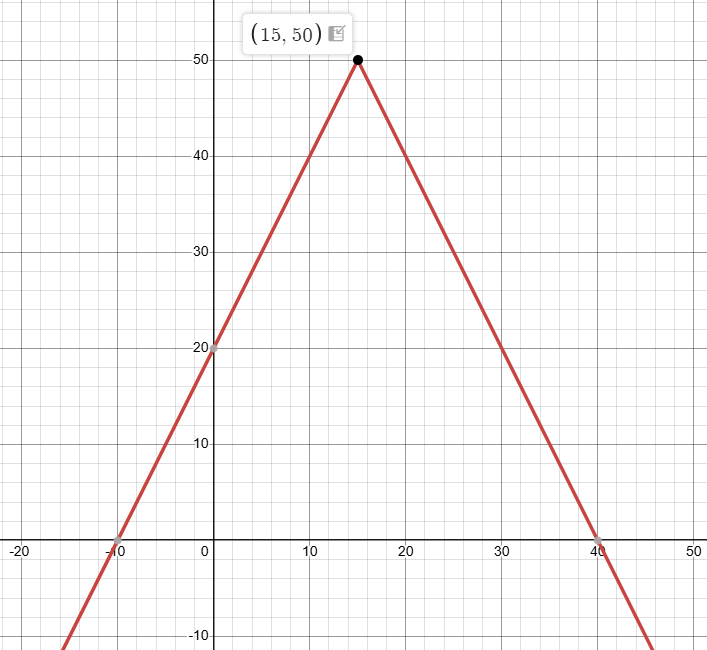
The number of pairs of shoes sold s (in thousands) increases and then decreases as described by the function s(t) = −2 ∣t − 15∣ + 50, where t is the time (in weeks).

a. Graph the function.
b. What is the greatest number of pairs of shoes sold in 1 week?
Solution :
a)
b) s(t) = −2 ∣t − 15∣ + 50
When t = 1
s(1) = −2 ∣1 − 15∣ + 50
= -2|-14| + 50
= -2(14) + 50
= -28 + 50
= 22
So, the greatest number of pair of shoes is 22.
Problem 11 :
Describe the transformations from the graph of g(x) = −2 ∣x + 1∣ + 4 to the graph of h(x) = ∣x∣ . Explain your reasoning.
Solution :
g(x) = −2 ∣x + 1∣ + 4
h(x) = ∣x∣
- Vertex of g(x) = (-1, 4)
- Vertical stretch of 2 units and
- Reflection across x-axis and opens down.
Subscribe to our ▶️ YouTube channel 🔴 for the latest videos, updates, and tips.
Recent Articles


-
Finding Range of Values Inequality Problems
May 21, 24 08:51 PM
Finding Range of Values Inequality Problems -
Solving Two Step Inequality Word Problems
May 21, 24 08:51 AM
Solving Two Step Inequality Word Problems -
Exponential Function Context and Data Modeling
May 20, 24 10:45 PM
Exponential Function Context and Data Modeling