FIND DOMAIN AND RANGE OF ABSOLUTE VALUE FUNCTION FROM GRAPH
Subscribe to our ▶️ YouTube channel 🔴 for the latest videos, updates, and tips.
What is domain from graph ?
The horizontal spread or the spreading over the x-axis is knowns as domain.
The vertical spread or the spreading over the y-axis is knowns as range.
For absolute value function, which is in the form of
y = a |x-h| + k
the domain will be all real values.
For example, considering the graph given below.
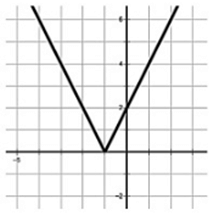
Domain :
The horizontal spread of the graph, or the spreading over all the x-axis. So, domain is {-∞, ∞}.
Range :
The vertical spread of the graph, or the spreading is above 0 on y-axis. So, range is {0, ∞}.
From each graph :
(i) Find vertex and write a function
(ii) State the domain and range
(iii) Intercept
(iv) axis of symmetry
Problem 1 :
Solution :
Equation of the function :
General form of absolute value function is y = a|x - h| + k
Vertex is at (-1, 0), the absolute value function is passing through the point (0, 2).
Applying the vertex,
y = a|x - (-1)| + 0
y = a|x + 1|
Applying the point (0, 2), we get
2 = a |0 + 1|
2 = a
So, the required function is
f(x) = 2|x + 1|
Domain :
All real value is domain.
Range :
[0, ∞), y ≥ 0
Axis of symmetry :
x = -1
Maximum / Minimum :
Minimum
Problem 2 :
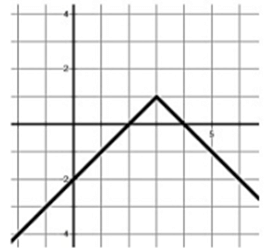
Solution :
Equation of the function :
General form of absolute value function is y = a|x - h| + k
Vertex is at (3, 1), the absolute value function is passing through the point (4,0).
Applying the vertex,
y = a|x - 3| + 1
Applying the point (4, 0), we get
0 = a |4 - 3| + 1
-1 = a
a = -1
So, the required function is
f(x) = -|x - 3| + 1
Domain:
All real value is domain.
Range:
[1,-∞), y ≤ 1
Axis of symmetry:
x = 3
Maximum / Minimum
Maximum
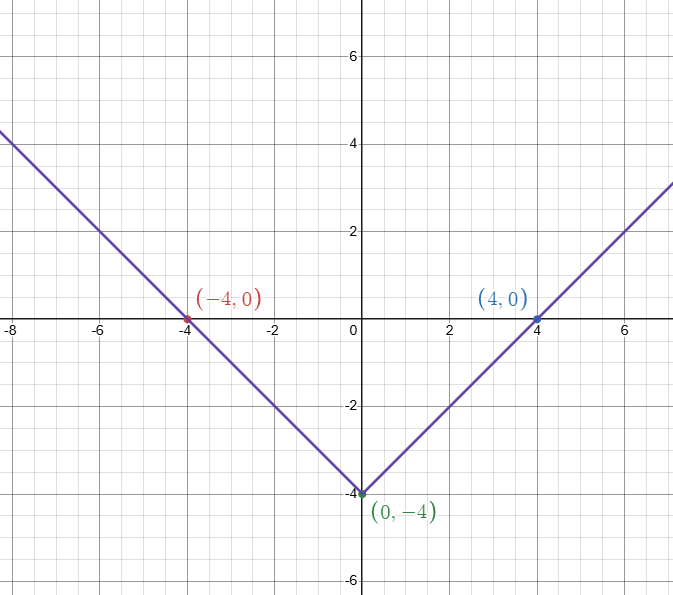
Graph the function. Compare the graph to the graph of f(x) = ∣x∣. Describe the domain and range.
Problem 3 :
f(x) = |x| - 4
Solution :
f(x) = |x| - 4
For any absolute value function, the domain is all real numbers.
Comparing the given function with y = a|x - h| + k
(h, k) is (0, -4)
- a = 1
- Since it is positive, the graph will open up.
- Domain is (-∞, ∞)
- Range is [-4, ∞)
|
x-intercept Put y = 0 |x| - 4 = 0 |x| = 4 x = -4 and x = 4 (-4, 0) and (4, 0) |
y-intercept Put x = 0 y = |0| - 4 y = -4 (0, -4) |
Problem 4 :
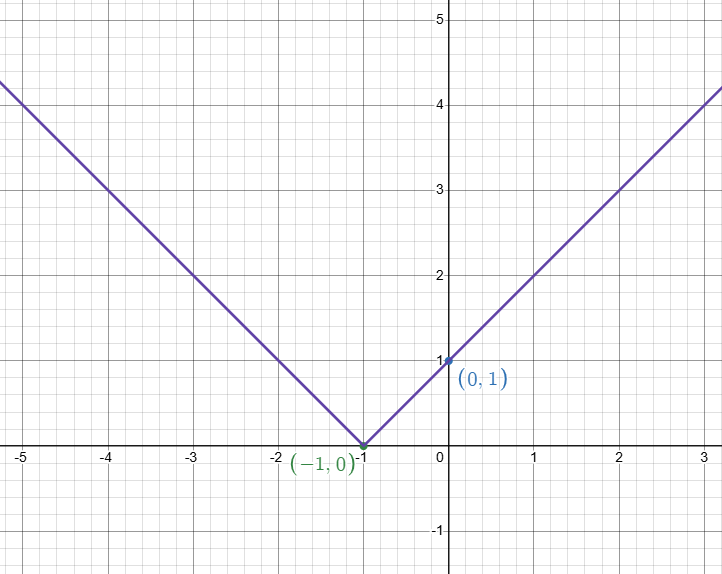
f(x) = |x + 1|
Solution :
f(x) = |x + 1|
Comparing the given function with y = a|x - h| + k
(h, k) is (-1, 0)
- a = 1
- Since it is positive, the graph will open up.
- Domain is (-∞, ∞)
- Range is [-1, ∞)
|
x-intercept Put y = 0 |x + 1| = 0 x + 1 = 0 x = -1 (-1, 0) |
y-intercept Put x = 0 y = |0 + 1| y = 1 (0, 1) |
Problem 5 :
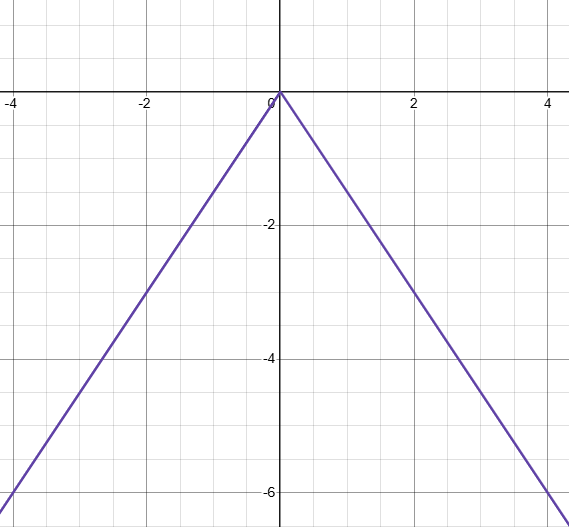
f(x) = (-3/2)|x|
Solution :
f(x) = (-3/2)|x|
Comparing the given function with y = a|x - h| + k
(h, k) is (0, 0)
- a = -3/2
- Since it is negative, the graph will open down.
- Domain is (-∞, ∞)
- Range is [0, -∞)
Problem 6 :
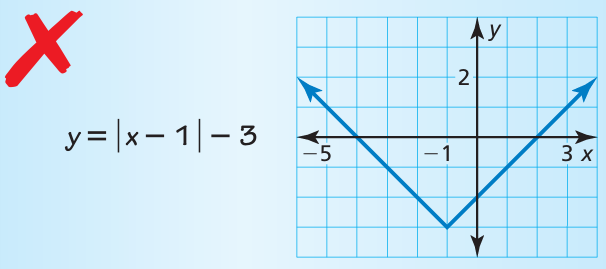
Describe and correct the error in graphing the function.
Solution :
Comparing the given function y = |x - 1| - 3 with y = a|x - h| + k
(h, k) is (1, -3)
By observing the graph, the vertex of the absolute value function is (-1, -3). That 's the error.
Problem 6 :
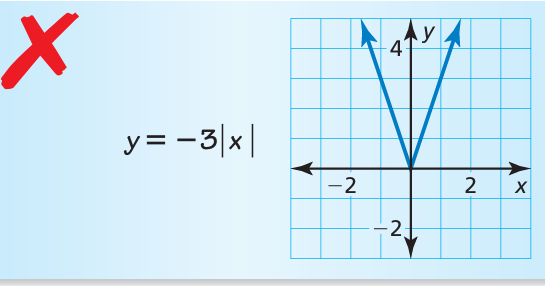
Describe and correct the error in graphing the function.
Solution :
Comparing the given function y = -3|x| with y = a|x - h| + k
(h, k) is (0, 0)
Since the sign of a is negative, the absolute value function must open down. By observing the graph, the function opens up. That is the error.
Problem 7 :
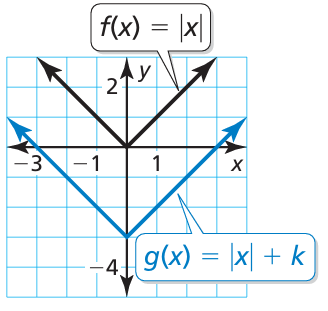
Compare the graphs. Find the value of h, k, or a.
Solution :
Comparing the graph in black, the blue graph is moved towards down of 3 units.
Describing the function g(x), we get
g(x) = |x| - 3
Comparing with y = a|x - h| + k
a = 1, h = 0 and k = -3
\Problem 8 :
Compare the graphs. Find the value of h, k, or a.
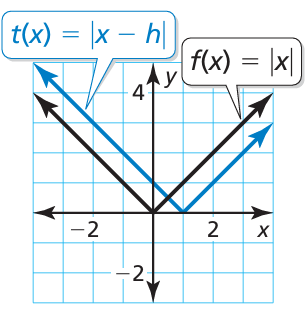
Solution :
Comparing the graph in black, the blue graph is moved towards right of 1 unit.
Describing the function g(x), we get
g(x) = |x - 1|
Comparing with y = a|x - h| + k
a = 1, h = 1 and k = 0
Subscribe to our ▶️ YouTube channel 🔴 for the latest videos, updates, and tips.
Recent Articles


-
Finding Range of Values Inequality Problems
May 21, 24 08:51 PM
Finding Range of Values Inequality Problems -
Solving Two Step Inequality Word Problems
May 21, 24 08:51 AM
Solving Two Step Inequality Word Problems -
Exponential Function Context and Data Modeling
May 20, 24 10:45 PM
Exponential Function Context and Data Modeling