FIND DEPENDENT AND INDEPENDENT VARIABLE
Subscribe to our ▶️ YouTube channel 🔴 for the latest videos, updates, and tips.
What's an independent variable?
An independent variable is exactly what it sounds like. It is a variable that stands alone and isn't changed by the other variables you are trying to measure.
For example, someone's age might be an independent variable. Other factors (such as what they eat, how much they go to school, how much television they watch) aren't going to change a person's age.
What's a dependent variable?
Just like an independent variable, a dependent variable is exactly what it sounds like. It is something that depends on other factors.
For example, a test score could be a dependent variable because it could change depending on several factors such as how much you studied, how much sleep you got the night before you took the test, or even how hungry you were when you took it.
Problem 1 :
As a babysitter, you earn $5 for every hour you babysit.
Which is the dependent variable?
A) Number of hours you babysit
B) Number of children you babysit
C) Amount of money you earn per hour
D) Total amount of money you earn
Solution :
Let x be the number of hours you baby sit. Let y be the amount he earns.
y = 5x
Dependent variable = Total amount of money you earn
Problem 2 :
Which is the independent variable in the following equation?
y = 3x + 9
A) y B) x C) 3 D) 9
Solution :
Independent variable = x
Here,
y = 3x + 9
if x = 1, y = 12
if x = 2, y = 15
So, x is the independent variable.
Problem 3 :
Mary can make 5 hair bows every hour.
Which is the independent variable?
A) Total number of hair bows Mary made
B) Number of hair bows made per hour
C) Number of hours Mary made bows
D) Price of each hair bow
Solution :
Independent variable = Number of hours Mary made bows
Here,
Total number of hair bows Mary can make depends on the number of hours.
Also, price of each bow depends on number of bows she’s making.
Problem 4 :
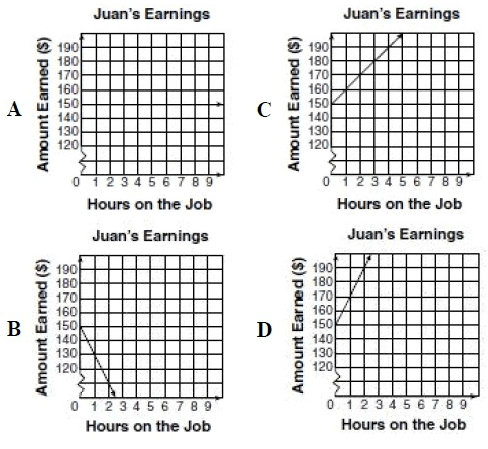
Juan earns flat fee of $150 plus $20 for every hour he works decorating a house. Which graph correctly displays Juan’s earnings?
Solution :
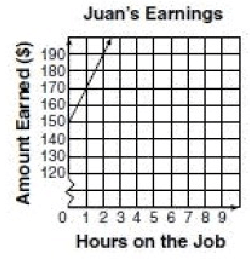
If he work one hour,
= 150 + 20 × 1
= 170
If he work two hour,
= 150 + 20 × 2
= 190
So, option (D) is correct.
Problem 5 :
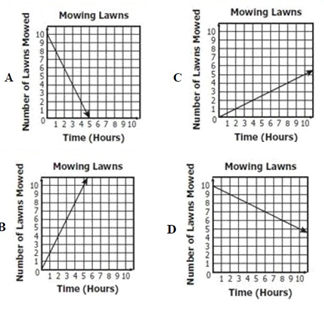
The table shows the number of hours it takes to mow a certain number of lawns.
|
Time 4 6 8 10 |
Number of lawns moved 2 3 4 5 |
which graph represents the relationship shown in the table ?
Solution :
For one hour, 2 lawns moved and for 2 hours, 4 lawns moved.
So, option (B) is correct.
Problem 6 :
The equation y = 128 − 8x gives the amount y (in fluid ounces) of milk remaining in a gallon jug after you pour x cups.
a. Identify the independent and dependent variables.
b. How much milk remains in the jug after you pour 10 cups?
Solution :
a) Because the amount y remaining depends on the number x of cups you pour, y is the dependent variable and x is the independent variable.
b) Use the equation to find the value of y when x = 10.
y = 128 − 8x
= 128 − 8(10)
= 48
There are 48 fluid ounces remaining.
Problem 7 :
The equation
y = 10x + 25
gives the amount y (in dollars) in your savings account after x weeks.
a. Identify the independent and dependent variables.
b. How much is in your savings account after 8 weeks?
Solution :
a) x is the independent variable and y is the dependent variable.
b) When x = 8
y = 10(8) + 25
= 80 + 25
y = 105
Problem 8 :
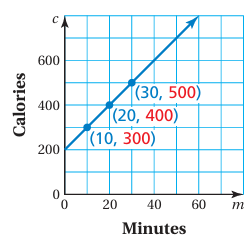
An athlete burns 200 calories weight lifting. The athlete then works out on an elliptical trainer and burns 10 calories for every minute. Write and graph an equation in two variables that represents the total number of calories burned during the workout.
Solution :
The total number of calories burned equals calories burned weight lifting plus calories burned per minute times the number of minutes.
Let c be the total number of calories burned, and let m be the number of minutes on the elliptical trainer.
c = 200 + 10 ⋅ m
To graph the equation, first make a table. Then plot the ordered pairs and draw a line through the points.
|
Minutes (m) 10 20 30 |
C = 200 + 10m C = 200 + 10(10) C = 200 + 10(20) C = 200 + 10(30) |
Calories(C) 200 + 100 ==> 300 200 + 200 ==> 400 200 + 300 ==> 500 |
Ordered pairs :
(10, 300) (20, 400) and (30, 500)
Problem 9 :
Identify the independent and dependent variables.
a) The equation A = 25w gives the area A (in square feet) of a rectangular dance floor with a width of w feet.
b) The equation c = 0.09s gives the amount c (in dollars) of commission a salesperson receives for making a sale of s dollars.
Solution :
a) A = 25w
w - width of the rectangle is independent variable
A - area of the rectangle, the dependent variable.
b) c = 0.09s
s - sales is the independent variable
c - amount in commission is the dependent variable.
Subscribe to our ▶️ YouTube channel 🔴 for the latest videos, updates, and tips.
Recent Articles


-
Finding Range of Values Inequality Problems
May 21, 24 08:51 PM
Finding Range of Values Inequality Problems -
Solving Two Step Inequality Word Problems
May 21, 24 08:51 AM
Solving Two Step Inequality Word Problems -
Exponential Function Context and Data Modeling
May 20, 24 10:45 PM
Exponential Function Context and Data Modeling