DIVISIBILITY RULE FOR 5
Subscribe to our ▶️ YouTube channel 🔴 for the latest videos, updates, and tips.
Rule :
If the last digit is 0 or 5 then the number is divisible by 5.
Problem 1 :
Which of these numbers are divisible by 5?
a) 400 b) 628 c) 735 d) 21063 e) 384 005
Solution :
If a number ends with 0 or 5, then it is divisible by 5.
a) 400
The given number 400 ends with 0.
So, the given number 400 is divisible by 5.
b) 628
The given number 628 does not end with 0 or 5.
So, the given number 628 is not divisible by 5.
c) 735
The given number 735 ends with 5.
So, the given number 735 is divisible by 5.
d) 21063
The given number 21063 does not end with 0 or 5.
So, the given number 21063 is not divisible by 5.
e) 384 005
The given number 384005 ends with 5.
So, the given number 384005 is divisible by 5.
Problem 2 :
Which one of the following numbers is completely divisible by 45 ?
a) 181560 b) 331145 c) 202860 d) 2033550
Solution :
If the number is divisible by 45, it should be divisible by 5 and 9.
Divisibility rule for 5 :
The unit digit should be 0 or 5.
Divisibility rule for 9 :
The sum of the digits should be 9.
a) 181560 is divisible by 5
1 + 8 + 1 + 5 + 6 + 0 => 21 (not divisible by 9)
181560 is not divisible by 45.
b) 331145 is divisible by 5
3 + 3 + 1 + 1 + 4 + 5 => 17 (not divisible by 9)
331145 is not divisible by 45.
c) 202860 is divisible by 5
2 + 0 + 2+ 8 + 6 + 0 => 18 (divisible by 9)
202860 is divisible by 45.
Problem 3 :
The sum of all two digit numbers divisible by 5 ?
a) 1035 b) 1245 c) 1230 d) 945
Solution :
The first two digit number which is divisible by 5 is 10.
Two digit numbers are divisible by 5 are
10, 15, 20, 25, .................95
By observing the sequence, it is arithmetic progression.
Finding number of terms :
tn = a + (n - 1)d
tn = 95, a = 10 and d = 15 - 10 ==> 5
95 = 10 + (n - 1)5
95 - 10 = 5(n - 1)
85/5 = n - 1
n - 1 = 17
n = 17 + 1
n = 18
There are 18 two digit numbers are divisible by 5.
Sum of the numbers :
sn = (n/2) [a + l]
s18 = (18/2)[10 + 95]
s18 = 945
Problem 4 :
What is the least number that could replace to make the number 36__5 divisible by 9?
a. 14 b. 5 c. 9 d. 4
Solution :
If the sum of the digits is divisible by 9, then the function is also divisible by 9.
Let x be the unknown digit.
= 3 + 6 + x + 5
= 14 + x
To make this number which is divisible by 9, we have to add 4 by this. So, option d is correct.
Problem 5 :
What is the least digit you would add to 44658 to make the number divisible by 5?
Solution :
Here the given number is 44658, the number which ends with 0 or 5 is divisible by 5. To make 44658 should be divisible by 5, we have to add 2 with 44658.
So, the least number should be added to make it divisible by 5 is 2.
Problem 6 :
Copy the diagram.
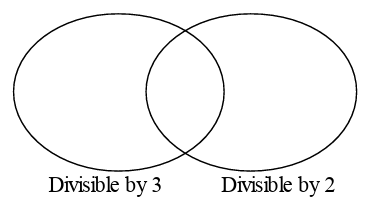
Place the numbers in the Venn diagram. 33, 12, 20, 14, 27, 18, 26, 39 Which numbers were placed in the overlapping region?
Solution :
- 33 is divisible by 3 not 2.
- 12 is divisible by 3 and 2
- 20 is divisible by 3 not 2.
- 14 is divisible by 2 not 3.
- 27 is divisible by 3 not 2
- 18 is divisible by 2 and 3.
- 26 is divisible by 2 not 3
- 39 is divisible by 3 not 2.
The number that we write in the overlapping region will be divisible by both 2 and 3. So, the answer is 12.
Problem 7 :
How many numbers are there from 400 to 700 which are divisible by 5, 6 and 7 ?
a) 5 b) 20 c) 2 d) 10
Solution :
When a number which is divisible by 5, 6 and 7, it also must be divisible by its least common multiple.
5 x 6 x 7 = 210
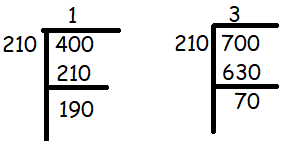
210 - 190 ==> 20
- 400 + 20 ==> 420 is the first number more than 400 which is divisible by 210.
- 700 - 70 ==> 630 is the last number which is lesser than 700 and it is divisible by 210
420, 630, ..........
So, the required number of terms in between 400 and 700 is 2.
Problem 8 :
How many numbers are from 300 to 650 which are divisible by both 5 and 7 ?
a) 8 b) 9 c) 10 d) 12
Solution :
When a number which is divisible by both 5 and 7, it is also divisible by 35.
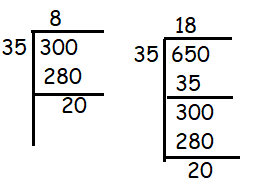
35 - 20 ==> 15
300 + 15 ==> 315
650 - 20 ==> 630
315, 350, 385, ................ 630
n = (last term - first term)/ difference + 1
= [(630 - 315)/35] + 1
= 315/35 + 1
= 9 + 1
= 10
so, there are 10 terms.
Problem 9 :
How many numbers are there between 1 and 200 which are divisible by 3 but not 7 ?
a) 38 b) 45 c) 57 d) 66
Solution :
3, 6, 9, 12, 15, 18, 21, 24, ................198 are multiples of 3
Here 21, 42, .................189 are multiples of 7 which is multiples of 21 also.
So, by subtracting multiples of 21 from multiples of 3, we will get the numbers which are multiples of 3 not by 7.
Number of multiples of 3 :
= (198 - 3)/3 + 1
= 195/3 + 1
= 65 + 1
= 66
Number of multiples of 21 :
= (189 - 21)/21 + 1
= 8 + 1
= 9
= 66 - 9
= 57
So, there are 57 multiples of 21.
Subscribe to our ▶️ YouTube channel 🔴 for the latest videos, updates, and tips.
Recent Articles


-
Finding Range of Values Inequality Problems
May 21, 24 08:51 PM
Finding Range of Values Inequality Problems -
Solving Two Step Inequality Word Problems
May 21, 24 08:51 AM
Solving Two Step Inequality Word Problems -
Exponential Function Context and Data Modeling
May 20, 24 10:45 PM
Exponential Function Context and Data Modeling