Divisibility Rule for 2
Subscribe to our ▶️ YouTube channel 🔴 for the latest videos, updates, and tips.
Rule :
If the last digit is 0 or even, then the original number is divisible by 2.
Problem 1 :
Which of these numbers are divisible by 2?
a) 216 b) 3184 c) 827 d) 4770 e) 123 456
Solution :
Any number that ends in a 0, 2, 4, 6, and 8 is can be divided by 2 to produce a whole number.
Note : So, all even numbers are divisible by 2.
a) 216 ends with the digit 6.
So, 216 is an even number and it is divisible by 2.
b) 3184 ends with the digit 4.
So, 3184 is an even number and is divisible by 2.
c) 827 ends with the digit 7.
So, 827 is not an even number, and it is not divisible by 2.
d) 4770 ends with the digit 0.
So, 4770 is an even number and is divisible by 2.
e) 123 456 ends with the digit 6.
So, 123 456 is an even number and is divisible by 2.
Problem 2 :
If a and b are odd numbers, then which of the following is even ?
a) a + b b) a + b + 1 c) ab d) ab + 2
Solution :
Here a and b are odd numbers, let us consider
a = 3 and b = 5
a + b => 3 + 5 ==> 8 (even)
The sum of two odd number is even.
That is, odd + odd = even
So, a + b is even.
Problem 3 :
n is a whole number when divided by 4 gives 3 as remainder What will be the remainder when 2n is divided by 4.
a) 3 b) 2 c) 1 d) 0
Solution :
Division algorithm,
Divided = divisor x quotient + remainder
Let q be the quotient.
n = 4q + 3
2n = 8q + 6
2n = 8q + 4 + 2
2n = 4(2q + 1) + 2
It exactly matches with division algorithm. Here 2q + 1 is quotient and 2 is remainder.
Problem 4 :
A number was divided successively in order by 4, 5 and 6. The remainders were respectively 2, 3 and 4. The number is
a) 214 b) 476 c) 954 d) 1908
Solution :
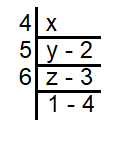
z = 6 (1) + 4
z = 10
y = 5z + 3
Applying the value of z, we get
y = 5(10) + 3 ==> y = 53
x = 4y + 2
Applying the value of y, we get
x = 4(53) + 2
x = 212 + 2
x = 214
So, the required number is 214.
Problem 5 :
Which number is divisible by 2?
75, 45, 46, 49
a. 75 b. 45 c. 49 d. 46
Solution :
A number which ends with 0, 2, 4, 6 or 8 is known as even number. Considering the options, 46 ends with 6. So, it is divisible by 2. Option d is correct.
Problem 6 :
Which number is divisible by 4?
34, 51, 68, 38
a. 68 b. 34 c. 51 d. 38
Solution :
68 is divisible by 4. So, option a is correct.
Problem 7 :
Which number is divisible by 2 but not by 4?
92, 115, 138, 184
a. 184 b. 138 c. 92 d. 115
Solution :
All even numbers will be divisible by 2, if the last two digits is divisible by 4 then the given number is also divisible by 4. Considering the given numbers 92, 138, 184 are even numbers, but 138 even though it is even number the last two digits 38 which is not divisible by 4. So, 138 is divisible by 2 but not divisible by 4.
Problem 8 :
Which number is divisible by 9?
324 581, 324 664, 324 747, 324 867
a. 324 664 b. 324 867 c. 324 581 d. 324 747
Solution :
If the sum of digits is divisible by 9, then the entire number is also divisible by 9.
Option a :
Sum of the digits of 324664,
= 3 + 2 + 4 + 6 + 6 + 4
= 25
25 is not divisible by 9, then 324664 is also not divisible by 9.
Option b :
Sum of the digits of 324867,
= 3 + 2 + 4 + 8 + 6 + 7
= 30
30 is not divisible by 9, then 324867 is also not divisible by 9.
Option c :
Sum of the digits of 324581,
= 3 + 2 + 4 + 5 + 8 + 1
= 23
23 is not divisible by 9, then 324581 is also not divisible by 9.
Option d :
Sum of the digits of 324 747,
= 3 + 2 + 4 + 7 + 4 + 7
= 27
27 is divisible by 9, then 324747 is divisible by 9.
Problem 9 :
Which number is divisible by 3 and by 5?
378, 380, 375, 385
a. 378 b. 385 c. 380 d. 375
Solution :
A number which ends with 0 or 5 will be divisible by 5. Considering 380, 375 and 385 all are divisible by 5.
- 3 + 8 + 0 = 11 (not divisible by 3)
- 3 + 7 + 5 = 15 (divisible by 3)
- 3 + 8 + 5 = 16 (not divisible by 3)
So, answer is option d.
Problem 10 :
Use the divisibility rules to find all the factors of 102.
a. 2, 3, 6, 17, 34, 51 b. 1, 2, 3, 6, 17, 102
c. 1, 2, 3, 6, 17, 34, 51, 102 d. 1, 2, 3, 102
Solution :
- Since 102 is even number it is divisible by 2.
- Since the sum of the digits 1 + 0 + 2 = 3, is divisible by 3, then 102 is also divisible by 3.
- 2 and 3 are factors of 6, then 102 is divisible by 6.
- 102 is divisible by 17, then it is divisible by 34. It is divisible by 51 (3 x 17).
- For every number 1 and itself will be the factors.
So, Option c is correct.
Subscribe to our ▶️ YouTube channel 🔴 for the latest videos, updates, and tips.
Recent Articles


-
Finding Range of Values Inequality Problems
May 21, 24 08:51 PM
Finding Range of Values Inequality Problems -
Solving Two Step Inequality Word Problems
May 21, 24 08:51 AM
Solving Two Step Inequality Word Problems -
Exponential Function Context and Data Modeling
May 20, 24 10:45 PM
Exponential Function Context and Data Modeling