DIFFERENCE QUOTIENT METHOD TO FIND INSTANTANEOUS RATE OF CHANGE
Subscribe to our ▶️ YouTube channel 🔴 for the latest videos, updates, and tips.
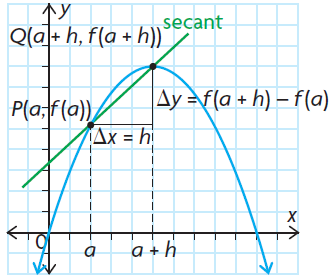
If P(a, f(a)) and Q(a + h, f(a + h)) are two points on the graph of y = f(x) then the instantaneous rate of change of y with respect to x at P can be estimated using
𐤃y/𐤃x = [f(a + h) - f(a)] / h
where h is very small number. This expression is called difference quotient
Problem 1 :
For the function f(x) = 6x2 - 4, estimate the instantaneous rate of change for the given values of x.
a) x = -2 b) x = 0 c) x = 4 d) x = 8
Solution :
a) Write the difference quotient for the average rate of change in volume as the side length changes between 2 and any value
𐤃y/𐤃x = [f(a + h) - f(a)] / h
f(x) = 6x2 - 4
f(-2) = 6(-2)2 - 4
= 6(4) - 4
= 24 - 4
= 20
[f(-2 + h) - f(-2)] / h = [(6(-2 + h)2 - 4) - 20] / h
= [6(-2 + h)2 - 24 - 20] / h
= [6(-2 + h)2 - 44] / h
Applying h = 0.01
= [6(-2 + 0.01)2 - 44] / 0.01
= [6(-1.99)2 - 44] / 0.01
= [6(3.9601) - 44] / 0.01
= -20.24/0.01
= -2023.94
Applying h = -0.01
= [6(-2 - 0.01)2 - 44] /( -0.01)
= [6(-2.01)2 - 44] / (-0.01)
= [6(4.04) - 44] / (-0.01)
= 19.76/0.01
= 1976
Average = [-2023.94 + 1976)] / 2
= -47.94/2
= -23.97
Approximately -24.
b) At x = 0
f(x) = 6x2 - 4
f(0) = 6(0)2 - 4
= 0 - 4
= -4
[f(0 + h) - f(0)] / h = [(6(0 + h)2 - 4) - (-4)] / h
= [6h2 - 4 + 4] / h
= 6h2 / h
= 6h
Applying h = 0.01
= 6(0.01)
= 0.06
Applying h = -0.01
= 6(-0.01)
= -0.06
Average = [0.06 + (-0.06)] / 2
= 0
c) at x = 4
f(4) = 6(4)2 - 4
= 6(4) - 4
= 96 - 4
= 92
[f(4 + h) - f(4)] / h = [(6(4 + h)2 - 4) - 92] / h
= [(6(16 + 8h + h2) - 4) - 92] / h
= [96 + 48h + 6h2 - 4 - 92] / h
= [96 + 48h + 6h2 - 96] / h
= [48h + 6h2] / h
= h(48 + 6h)/h
= 48 + 6h
Applying h = 0.01
= 48 + 6(0.01)
= 48 + 0.06
= 48.06
Applying h = -0.01
= 48 + 6(-0.01)
= 48 - 0.06
= 47.94
Average = [48.06 + 47.94] / 2
= 96/2
= 48
d) at x = 8
f(x) = 6x2 - 4
f(8) = 6(8)2 - 4
= 6(64) - 4
= 384 - 4
= 380
[f(8 + h) - f(8)] / h = [(6(8 + h)2 - 4) - 380] / h
= [6(8 + h)2 - 24 - 380] / h
= [6(8 + h)2 - 404] / h
Applying h = 0.01
= [6(8 + 0.01)2 - 404] / 0.01
= [6(8.01)2 - 404] / 0.01
= [6(64.16) - 404] / 0.01
= [384.96 - 404] / 0.01
= [384.96 - 404] / 0.01
= -19.03/0.01
= -1903.94
Applying h = -0.01
= [6(8 - 0.01)2 - 404] / (-0.01)
= [6(7.99)2 - 404] / (-0.01)
= [6(63.84) - 404] / (-0.01)
= [383.04 - 404] / (-0.01)
= [384.96 - 404] / (-0.01)
= -20.95/(-0.01)
= 2095.94
Average = [-1903.94 + 2095.94] / 2
= 192/2
96
Problem 2 :
An object is sent through the air. Its height is modelled by the function
h(x) = -5x2 + 3x + 65
where h(x) is the height of the object in meters and x is the time in seconds. Estimate the instantaneous rate of change in the object’s height at 3 s.
Solution :
Write the difference quotient for the average rate of change in volume as the side length changes between 2 and any value
𐤃y/𐤃x = [f(a + h) - f(a)] / h
h(x) = -5x2 + 3x + 65
f(3) = -5(3)2 + 3(3) + 65
= -5(9) + 9 + 65
= -45 + 74
= 29
f(3 + h) = -5(3 + h)2 + 3(3 + h) + 65
= -5(9 + 6h + h2) + 9 + 3h + 65
= -45 - 30h - 5h2 + 9 + 3h + 65
= -45 - 27h - 5h2 + 74
= - 27h - 5h2 + 29
[f(3 + h) - f(3)] / h = [(- 51h - 5h2 + 29) - 29] / h
= (-27h - 5h2) / h
= h(- 27 - 5h) / h
= (- 27 - 5h)
Applying h = 0.01
= -(27 + 5(0.01))
= - (27 + 0.05)
= -27.05
Applying h = -0.01
= -(27 + 5(-0.01))
= - (27 - 0.05)
= -26.95
Average = [-27.05 - 26.95] / 2
= 54/2
= 27 m/s
So, the required rate of change is 27 meter/second.
Your second block of text...
Subscribe to our ▶️ YouTube channel 🔴 for the latest videos, updates, and tips.
Recent Articles


-
Finding Range of Values Inequality Problems
May 21, 24 08:51 PM
Finding Range of Values Inequality Problems -
Solving Two Step Inequality Word Problems
May 21, 24 08:51 AM
Solving Two Step Inequality Word Problems -
Exponential Function Context and Data Modeling
May 20, 24 10:45 PM
Exponential Function Context and Data Modeling