DETERMINE IF THREE SIDES FORM A RIGHT TRIANGLE
Subscribe to our ▶️ YouTube channel 🔴 for the latest videos, updates, and tips.
By using Pythagorean theorem, we can determine whether the three sides will create a right triangle.
a2 = b2 + c2
Here the longest side can be considered as hypotenuse. We have to check, if the square of the longest side is equal to the some of squares of the remaining sides.
- If it is true, then we can decide the given sides will be sides of right triangle.
- If it is not true, then we can decide the given sides will not create right triangle.
The following figures are not drawn to scale. Which of the triangles are right angled?
Problem 1 :
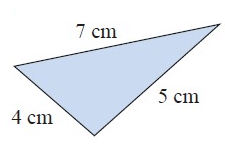
Solution :
Using
Pythagorean theorem.
72 = 42 + 52
49 = 16 + 25
49 ≠ 41
So, it is not a right triangle.
The following figures are not drawn to scale. Which of the triangles are right angled?
Problem 2 :
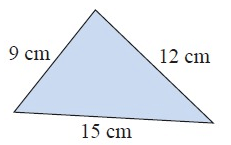
Solution :
The measure of longest side = 15
a = 15, b = 12 and c = 9
Using Pythagorean theorem.
152 = 122 + 92
225 = 144 + 81
225 = 225
So, it is a right triangle.
Problem 3 :
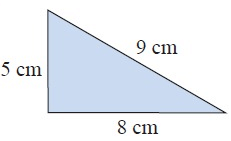
Solution :
The measure of longest side = 9 cm
a = 9, b = 8 and c = 5
Using Pythagorean theorem.
92 = 82 + 52
81 = 64 + 25
81 ≠ 89
So, it is not a right triangle.
Problem 4 :
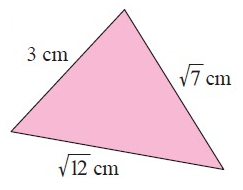
Solution :
The measure of longest side = √12
a = √12, b = √7 and c = 3
Using Pythagorean theorem.
(√12)2 = (√7)2 + 32
12 = 7 + 9
12 ≠ 16
So, it is not a right triangle.
Problem 5 :
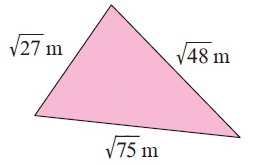
Solution :
The measure of longest side = √75
a = √75, b = √48 and c = √27
Using Pythagorean theorem.
(√75)2 = (√48)2 + (√27)2
75 = 48 + 27
75 = 75
So, it is a right triangle.
Problem 6 :
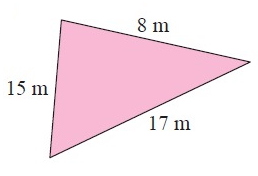
Solution :
The measure of longest side = √75
a = √75, b = √48 and c = √27
Using Pythagorean theorem.
172 = 152 + 82
289 = 225 + 64
289 = 289
So, it is a right triangle.
Problem 7 :
Determine the area and perimeter of the triangle shown on the right.
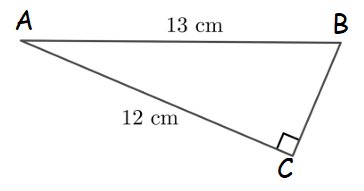
Solution :
To find area of the triangle, we need the height of the triangle.
AB2 = AC2 + BC2
132 = 122 + BC2
BC2 = 169 - 144
BC2 = 25
BC = 5 cm
Perimeter of the triangle = AB + BC + CA
= 13 + 5 + 12
= 30 cm
Area of triangle = (1/2) x AB x BC
= (1/2) x 13 x 5
= 65/2
= 32.5 cm2
Problem 8 :
A rectangular park has a straight path from one corner to the opposite corner. If the park has dimensions of 2 km by 1.4 km, determine the length of the path.
Solution :
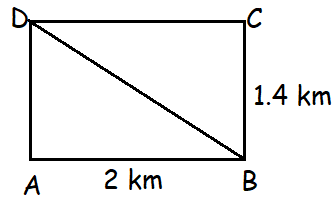
DB2 = AB2 + AD2
DB2 = 22 + 1.42
= 4 + 1.96
= 5.96
DB = 2.44 km
So, the length of the path is 2.44 km.
Problem 9 :
A 12-foot ladder is leaned against the side of a building. If the bottom of the ladder rests 3 feet from the wall, determine the height at which the top of the ladder rests on the wall.
Solution :
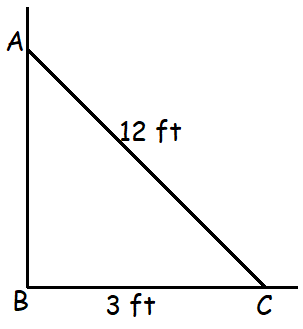
Height of the top of ladder rests on the wall :
AC2 = AB2 + BC2
122 = AB2 + 32
144 - 9 = AB2
AB2 = 135
AB = √135
= √(5 x 3 x 3 x 3)
= 3 √15
So, the required height is 3 √15 ft
Problem 10 :
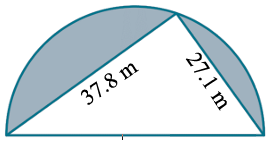
When a triangle is inscribed in a semicircle, a right angle is always formed at the point on the circular arc. Calculate the area of the shaded region in the diagram below.
Solution :
Angle in a semi circle is a right angle.
Diameter of the circle = base of the triangle
Diameter2 = 37.82 + 27.12
Diameter2 = 1428.84 + 734.41
Diameter2 = 2163.25
Diameter = √2163.25
= 46.5 m
Radius = 23.25 ft
Area of semicircle = (1/2) πr2
= (1/2) ⋅ 3.14 ⋅ (23.25)2
= 1.57 ⋅ 540.5625
= 848.68 square feet
Area of triangle = (1/2) ⋅ base ⋅ height
= (1/2) ⋅ 46.5 ⋅ 27.1
= 23.25 ⋅ 27.1
= 630.075 square feet
Area of the shaded region = area of semicircle - area of triangle
= 848.68 - 630.075
= 218.605 square ft
Problem 11 :
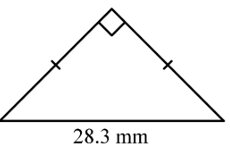
Determine the perimeter of the triangle shown on the right.
Solution :
Let x be the measure of equal sides.
28.32 = x2 + x2
2x2 = 800.39
x2 = 800.39/2
x2 = 400.445
x = √ 400.445
x = 20 (approximately)
Perimeter of the triangle = 2x + 28.3
= 2(20) + 28.3
= 40 + 28.3
= 68.3 mm
Problem 12 :
A television screen has a width-to-height ratio of 16:9. If the diagonal of the screen is 65 inches, determine its width and height.
Solution :
Width = 16x
height = 9x
652 = (16x)2 + (9x)2
4225 = 256x2 + 81x2
4225 = 337x2
x2 = 4225/337
x2 = 12.53
x = √12.53
= 3.54
Width = 16 x ==> 16(3.54) ==> 56.64 inches
height = 9x ==> 9(3.54) ==> 31.86 inches
So, width and height are 57 inches and 32 inches respectively.
Subscribe to our ▶️ YouTube channel 🔴 for the latest videos, updates, and tips.
Recent Articles


-
Finding Range of Values Inequality Problems
May 21, 24 08:51 PM
Finding Range of Values Inequality Problems -
Solving Two Step Inequality Word Problems
May 21, 24 08:51 AM
Solving Two Step Inequality Word Problems -
Exponential Function Context and Data Modeling
May 20, 24 10:45 PM
Exponential Function Context and Data Modeling