DETERMINE A QUADRATIC EQUATION GIVEN THE ROOTS AND A POINT
Subscribe to our ▶️ YouTube channel 🔴 for the latest videos, updates, and tips.
The quadratic function will be in the form
y = ax2 + bx + c
this will have two roots α and β.
Roots = zeroes = x-intercepts
To find quadratic function from the given roots, we follow the steps give below.
Step 1 :
The given roots can be converted into factored form
x = α ==> (x - α)
x = β ==> (x - β)
y = a(x - α)(x - β)
Step 2 :
To figure out the value of a, we apply the given point.
Problem 1 :
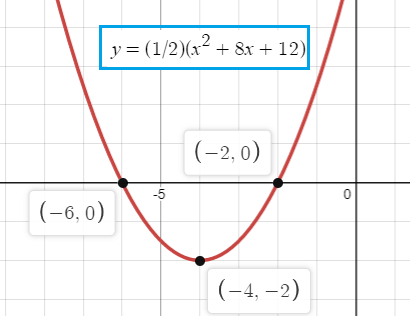
The roots of a quadratic equation are -2 and -6. The minimum point of the graph of its related function is at (-4, -2). Sketch the graph of the function.
Solution :
α = -2 and β = -6
α + β = -2 - 6 ==> -8
α β = -2 (-6) ==> 12
The quadratic function will be,
y = a(x2 - (-8)x + 12)
y = a(x2 + 8x + 12)
Since the quadratic function is having a minimum point (-4, -2), the will pass through this point.
-2 = a((-4)2 + 8(-4) + 12)
-2 = a(16 - 32 + 12)
-2 = a(-4)
a = 1/2
By applying the value of a, we get
y = (1/2)(x2 + 8x + 12)
So, the required quadratic function is
y = (1/2)(x2 + 8x + 12)
Problem 2 :
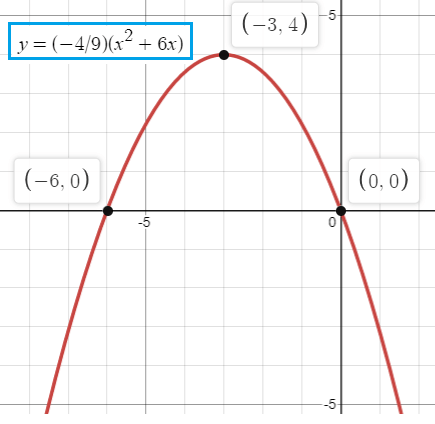
The roots of a quadratic equation are -6 and 0. The minimum point of the graph of its related function is at (-3, 4). Sketch the graph of the function.
Solution :
α = -6 and β = 0
α + β = -6 + 0 ==> -6
α β = -6 (0) ==> 0
The quadratic function will be,
y = a(x2 - (-6)x + 0)
y = a(x2 + 6x)
Since the quadratic function is having a minimum point (-3, 4), the will pass through this point.
4 = a((-3)2 + 6(-3))
4 = a(9 - 18)
4 = a(-9)
a = -4/9
By applying the value of a, we get
y = (-4/9)(x2 + 6x)
So, the required quadratic function is
y = (-4/9)(x2 + 6x)
Problem 3 :
Which of the following x equations represent the parabola?
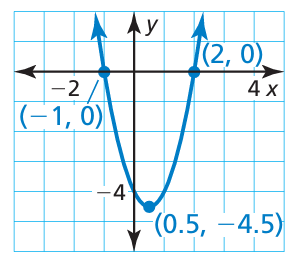
a) y = 2(x − 2)(x + 1) b) y = 2(x + 0.5)2 − 4.5 c) y = 2(x − 0.5)2 − 4.5
d) y = 2(x + 2)(x − 1)
Solution :
The roots are -1 and 2. That is, x = -1 and x = 2
The factors are (x + 1) and (x - 2).
The quadratic function is f(x) = a(x + 1) (x - 2)
Applying the point (0.5, -4.5), we get
f(0.5) = a(0.5 + 1) (0.5 - 2)
-4.5 = a(1.5) (-1.5)
-4.5 = a(-2.25)
a = 4.5/2.25
a = 2
f(x) = 2(x + 1) (x - 2)
So, option a is correct.
Problem 4 :
x-intercepts of 12 and −6; passes through (14, 4)
Solution :
Given that x-intercepts are 12 and -6. That is, x = 12 and x = -6
The factor form is (x - 12) (x + 6)
The quadratic function is f(x) = a(x + 1) (x - 2)
Applying the point (14, 4), we get
f(14) = a(14 - 12) (14 + 6)
4 = a(2)(20)
4 = 40a
a = 4/40
a = 1/10
Applying the value of a, we get
f(x) = (1/10)(x + 1) (x - 2)
Problem 5 :
x-intercepts of 9 and 1; passes through (0, −18)
Solution :
Given that x-intercepts are 9 and 1. That is, x = 9 and x = 1
The factor form is (x - 9) (x - 1)
The quadratic function is f(x) = a (x - 9) (x - 1)
Applying the point (0, -18), we get
f(0) = a (0 - 9) (0 - 1)
-18 = a(-9)(-1)
-18 = 9a
a = -18/9
a = -2
Applying the value of a, we get
f(x) = -2 (x - 9) (x - 1)
Problem 6 :
x-intercepts of −16 and −2; passes through (−18, 72)
Solution :
Given that x-intercepts are -16 and -2. That is, x = -16 and x = -2
The factor form is (x + 16) (x + 2)
The quadratic function is f(x) = a (x + 16) (x + 2)
Applying the point (-18, 72), we get
f(-18) = a(-18 + 16) (-18 + 2)
72 = a(-2)(-16)
72 = 32a
a = 72/32
a = 2.25
Applying the value of a, we get
f(x) = 2.25 (x + 16) (x + 2)
Problem 7 :
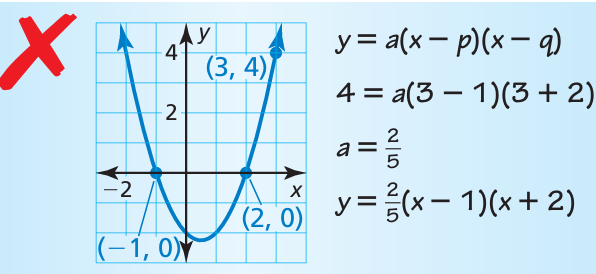
Describe and correct the error in writing an equation of the parabola.
Solution :
By observing the x-intercepts, those are -1 and 2
Factored form is (x + 1)(x - 2)
y = a(x + 1)(x - 2)
The parabola passes through the point (3, 4), we get
4 = a(3 + 1)(3 - 2)
4 = a(4)(1)
4 = 4a
a = 4/4
a = 1
Applying the value of a, we get
y = 1(x + 1)(x - 2)
Subscribe to our ▶️ YouTube channel 🔴 for the latest videos, updates, and tips.
Recent Articles


-
Finding Range of Values Inequality Problems
May 21, 24 08:51 PM
Finding Range of Values Inequality Problems -
Solving Two Step Inequality Word Problems
May 21, 24 08:51 AM
Solving Two Step Inequality Word Problems -
Exponential Function Context and Data Modeling
May 20, 24 10:45 PM
Exponential Function Context and Data Modeling