CALCULATE MISSING FREQUENCY WHEN MEAN IS GIVEN
Subscribe to our ▶️ YouTube channel 🔴 for the latest videos, updates, and tips.
Problem 1 :
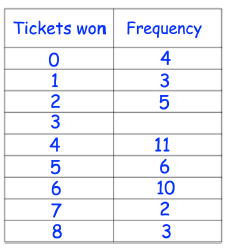
Aidan plays 50 games in an arcade. The table shows how many tickets he won in each game.
(a) Work out the missing frequency
(b) Work out the total number of tickets won
(c) Work out the mean number of tickets won per game.
Aidan wants to exchange his ticket for a prize that costs 800 tickets.
(d) How many more games do you expect Aidan would have to play?
Solution :
Let x be the missing frequency.
a) Total number of games played = 50
4 + 3 + 5 + x + 11 + 6 + 10 + 2 + 3 = 50
12 + x + 32 = 50
44 + x = 50
x = 50 - 44
x = 6
b) Number of tickets won =
0(4) + 1(3) + 2(5) + 3x + 4(11) + 5(6) + 6(10) + 7(2) + 8(3)
= 0 + 3 +10 + 3x + 44 + 30 + 60 + 14 + 24
= 13 + 3x + 172
= 185 + 3x
= 185 + 3(6)
= 185 + 18
= 203
c) Mean number of tickets = 203 / 50
= 4.06
d) 800 - 203
= 597
= 597/4.06
= 147
Expected number of games = 147.
Problem 2 :
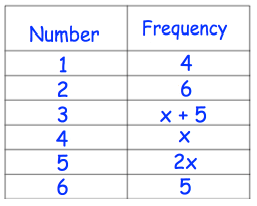
Max rolls a dice 80 times. The table shows the results.
(a) Find the value of x
(b) Work out the mean score
Solution :
Number of times he rolls the dice = 80
4 + 6 + x + 5 + x + 2x + 5 = 80
20 + 4x = 80
4x = 80 - 20
4x = 60
x = 60/4
x = 15
b) Mean = 80/6
= 13.3
Problem 3 :
A student was asked to find the arithmetic mean of the numbers 3, 11, 7, 9, 15, 13, 8, 19, 17, 21, 14 and x. He found the mean to be 12. What should be the number in the place of x ?
Solution :
Mean = 12
(3+11+7+9+15+13+8+19+17+21+14+x) / 12 = 12
137 + x = 144
x = 144 - 137
x = 7
Problem 4 :
The average of 2, 7, 6 and x is 5 and the average of 18, 1, 6, x and y is 10. What is the value of y.
Solution :
Let {2, 7, 6, x} be the first data set
Average = 5
(2 + 7 + 6 + x)/4 = 5
15 + x = 20
x = 20 - 15
x = 5
Let {18, 1, 6, x and y is 10} be the second data set.
(18 + 1 + 6 + x + y + 10)/6 = 10
35 + x + y = 60
Applying the value of x,
35 + 5 + y = 60
40 + y = 60
y = 60 - 40
y = 20
So, the missing values are x = 5 and y = 20.
Problem 5 :
If the mean of 5 observations x, x + 2, x + 4, x + 6 and x + 8 is 11, then the mean of the last three observation is.
Solution :
Mean of 5 observations = 11
(x + x + 2 + x + 4 + x + 6 + x + 8) / 5 = 11
5x + 20 = 55
5x = 55 - 20
5x = 35
x = 35/5
x = 7
Mean of last three observations :
= (x + 4 + x + 6 + x + 8)/3
= (3x + 18)/3
= [3(7) + 18] / 3
= (21 + 18)/3
= 39/3
= 13
Problem 6 :
The mean of the following frequency distribution is 25.2. Find the missing frequency x.
|
Class 0 - 10 10 - 20 20 - 30 30 - 40 40 - 50 |
Frequency 8 x 10 11 9 |
Solution :
|
Class 0 - 10 10 - 20 20 - 30 30 - 40 40 - 50 |
Frequency 8 x 10 11 9 |
Midpoint 5 15 25 35 45 |
f x 40 15x 250 385 405 |
Total frequency = 8 + x + 10 + 11 + 9
= 38 + x
Sum of fx = 40 + 15x + 250 + 385 + 405
= 1080 + 15x
Mean = (1080 + 15x)/(38 + x)
25.2 = (1080 + 15x)/(38 + x)
25.2(38 + x) = 1080 + 15x
957.6 + 25.2x = 1080 + 15x
25.2x - 15 = 1080 - 957.6
10.2x = 122.4
x = 122.4/10.2
x = 12
So, the missing frequency is 12.
Problem 7 :
Find the missing frequency: mean = 50, Total frequency = 120.
|
x 10 30 50 70 90 |
f 17 f1 32 f2 19 |
Solution :
|
x 10 30 50 70 90 |
f 17 f1 32 f2 19 |
f x 170 30f1 1600 70f2 1710 |
Mean = 50
Total frequency = 120
17 + f1 + 32 + f2 + 19 = 120
68 + f1 + f2 = 120
f1 + f2 = 120 - 68
f1 + f2 = 52 -----(1)
Mean = (170 + 30f1 + 1600 + 70f2 + 1710) / Total frequency
50 = (3480 + 30f1 + 70f2)/120
50(120) = 3480 + 30f1 + 70f2
6000 = 3480 + 30f1 + 70f2
6000 - 3480 = 30f1 + 70f2
2520 = 30f1 + 70f2
Dividing by 10, we get
252 = 3f1 + 7f2
3f1 + 7f2 = 252 -----(2)
(1) ⋅ 3 ==> 3f1 + 3f2 - (3f1 + 7f2) = 156 - 252
3f2 - 7f2 = -96
-4f2 = -96
f2 = 96/4
f2 = 24
Applying the value of f2 in (1), we get
f1 + 24 = 52
f1 = 52 - 24
f1 = 28
So, the missing frequencies are 28 and 24 respectively.
Subscribe to our ▶️ YouTube channel 🔴 for the latest videos, updates, and tips.
Recent Articles


-
Finding Range of Values Inequality Problems
May 21, 24 08:51 PM
Finding Range of Values Inequality Problems -
Solving Two Step Inequality Word Problems
May 21, 24 08:51 AM
Solving Two Step Inequality Word Problems -
Exponential Function Context and Data Modeling
May 20, 24 10:45 PM
Exponential Function Context and Data Modeling