SAT PRACTICE PROBLEMS ON SPECIAL RIGHT TRIANGLES
Subscribe to our ▶️ YouTube channel 🔴 for the latest videos, updates, and tips.
Problem 1 :
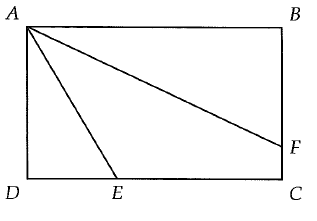
In rectangle ABCD above, E is on DC, F is on BC, DE = 6 and FC = 1. If the angle A is trisected (divided into three equal angles) by AE and AF, what is the length of BF ?
(a) 5 (b) 5√2 - 1 (c) 5√3-1 (d) 6√3-1
Solution :
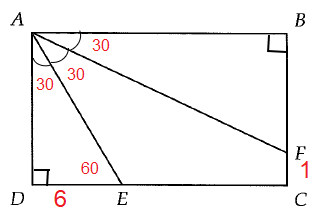
In Δ ADE,
Hypotenuse = AE, Shorter leg = DE = 6 and Longer leg = AD
Hypotenuse = 2(Shorter leg)
Hypotenuse = 2(6) ==> 12
Longer leg = √3(Shorter leg)
Longer leg = √3(6)
= 6√3
BC = 6√3
BF = BC - FC
BF = 6√3 - 1
So, the length of BF is 6√3 - 1.
Problem 2 :
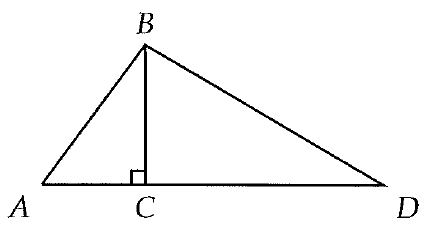
In triangle ABD above, AB = 10, AC = 6 and CD = 8√3. What is the length of BD ?
Solution :
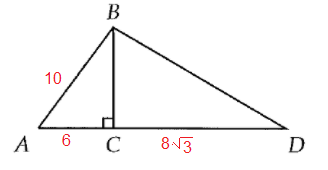
In triangle ABC.
Using Pythagorean theorem :
AB2 = AC2 + BC2
102 = 62 + BC2
100 - 36 = BC2
BC2 = 64
BC = 8
In triangle BCD.
BD2 = BC2 + CD2
BD2 = 82 + (8√3)2
BD2 = 64 + 192
BD2 = 256
BD = 16
Problem 3 :
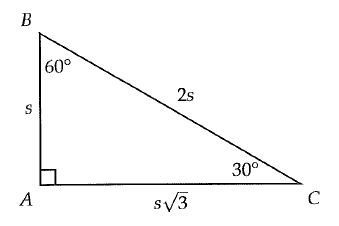
In triangle ABC above, the lengths of the sides relate to one another as shown. If the new triangle is created by increasing s by 40 percent and maintaining the relationships among the sides, the area of the new triangle is how many times greater than the area of the triangle ABC ?
(a) 1.16 (b) 1.96 (c) 1.98 (d) 2.16
Solution :
Area of triangle ABC = (1/2) x base x height
= (1/2) x s√3 x s
= √3 s2/2
The new triangle is created by increasing s by 40%, we get
= (1/2) x 140% of s√3 x 140% of s
= (1/2) x 1.4 s√3 x 1.4 s
= 1.96√3 s2/2
= 1.96(Area of triangle before the changes done)
Problem 4 :
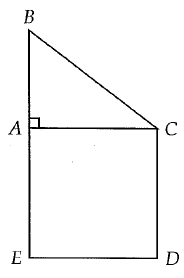
In the figure above, ACDE is square and ABC is a right triangle. If AB = 3 and BC = 5, what is the length of BD ?
(a) √53 (b) √62 (c) 8 (d) √65
Solution :
AB = 3 and BC = 5
BC2 = AB2 + AC2
52 = 32 + AC2
25 - 9 = AC2
AC2 = 16
AC = 4
BD2 = BE2 + ED2
BD2 = (4+3)2 + 42
BD2 = 72 + 42
BD2 = 49+16
BD2 = 65
BD = √65
Problem 5 :
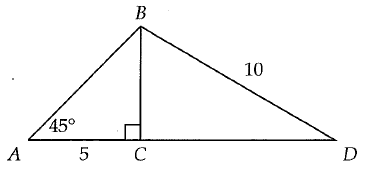
In triangle ABD above, AC = 5 and BD = 10. What is the length of CD ?
Solution :
AC = 5, BC = 5
In triangle BDC,
BD2 = BC2 + CD2
102 = 52 + CD2
CD2 = 100 - 25
CD2 = 75
CD = √75
CD = 5√3
So, the length of CD is 5√3.
Problem 6 :
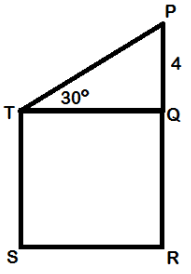
In the figure shown, ΔPQT is a right triangle, and QRST is a square. Find the area of the square, QRST
Solution :
PTQ is right triangle, TQ is perpendicular to PR.
∠TQP = 90
Triangle PTQ is 30-60-90.
Longer leg = TQ, shorter leg = PQ = 4
Hypotenuse = 2 (shorter leg)
= 2(4)
= 8
Longer leg = √3(shorter leg)
= √3(4)
= 4√3
Area of square = Side x side
= 4√3 x 4√3
= 16(3)
= 48
Problem 7 :
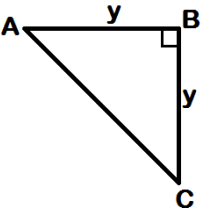
Using the figure above, we are given that the perimeter of ΔABC is 4 + 2√2. Find the value of y.
Solution :
AC2 = AB2 + BC2
AC2 = y2 + y2
AC2 = 2y2
AC = √(2y2)
AC = y√2
Perimeter of triangle ABC = AB + BC + CA
y√2 + y + y = 4 + 2√2
2y+ y√2 = 4 + 2√2
y(2 + √2) = 2(2 +√2)
y = 2
So, the value of y is 2.
Problem 8 :
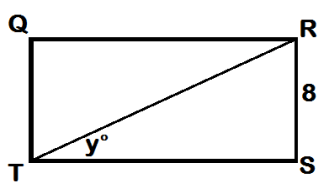
Using the figure above, we are given that QRST is a rectangle, and y = 30º. Find the length of RQ.
Solution :
In Triangle TSR, 30 - 60 - 90
∠RTS = y = 30º
RS = 8 = Shorter leg
Longer leg = TS = RQ
Longer leg = √3(Shorter leg)
= √3 (8)
TS = RQ = 8√3
Problem 9 :
Given a square with diagonal of length 6, calculate the area of the square.
(a) 9 (b)12 (c) 18 (d) 24 (e) 36
Solution :
Length of the diagonal = 6
Side length of square is "x"
x2 + x2 = 62
2x2 = 36
x2 = 18
x = 3√2
Area of the square = 3√2(3√2)
= 9(2)
= 18
Problem 10 :
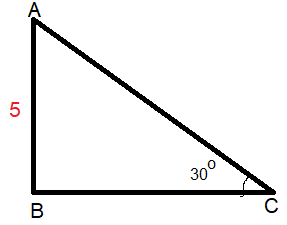
What is the length of AC.
(a) 5√3 (b) 10 (c) 15 (d) 10√3
Solution :
Shorter side = AB = 5
longer side = BC
Hypotenuse = AC = 2(Shorter side)
= 2(5)
AC = 10
Problem 11 :
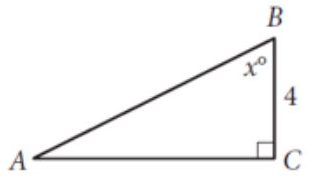
In the right triangle above x = 60. What is the length of AB?
a) 7 b) 8 c) 9 d) cannot be detemined.
Solution :
∠ABC = 60º (given)
∠ACB = 90º (given)
Then ∠BAC = 30º (given)
In 30-60-90 triangle, AB is hypotenuse. Smaller side = 4
Hypontenuse (AB) = 2 (smaller side)
= 2(4)
= 8
So, option b is correct.
Subscribe to our ▶️ YouTube channel 🔴 for the latest videos, updates, and tips.
Recent Articles


-
Finding Range of Values Inequality Problems
May 21, 24 08:51 PM
Finding Range of Values Inequality Problems -
Solving Two Step Inequality Word Problems
May 21, 24 08:51 AM
Solving Two Step Inequality Word Problems -
Exponential Function Context and Data Modeling
May 20, 24 10:45 PM
Exponential Function Context and Data Modeling